Cutting your best long-form moment into a Short and expecting it to perform the same way is where this usually goes wrong. A moment that held viewers because of everything that came before it has no such support in a Short — it opens cold, gets judged in the first second, and either earns a rewatch or gets swiped past. This article treats clip selection as step one of two, not the whole job: pick from the retention graph, then rebuild the opening for a format that owes the viewer nothing.
Why a good long-form moment can still fail as a Short
A moment that works in your long video is often working because of context: the setup two minutes earlier, the question the video already made the viewer curious about, the trust built over the first few minutes. Strip that away and drop the moment into a nine-second clip, and none of that context travels with it.
Long-form and Shorts are not judged by the same standard once published — a Short lives or dies on whether it earns an immediate rewatch, with none of the runway a fifteen-minute video gets. That's the reframe this whole process depends on: you are not looking for a good moment. You are looking for raw material that can be rebuilt to work without any lead-in at all.
Start from the retention graph, not the transcript
The fastest way to find candidate moments is to open the long video's retention curve and look for where it holds flat or spikes, not where you remember liking the delivery. Retention holding or climbing at a point in the video is a signal that viewers who were already watching chose to keep watching there — that's a stronger starting signal than your own read of the transcript, because it's about what actually happened rather than what you intended.
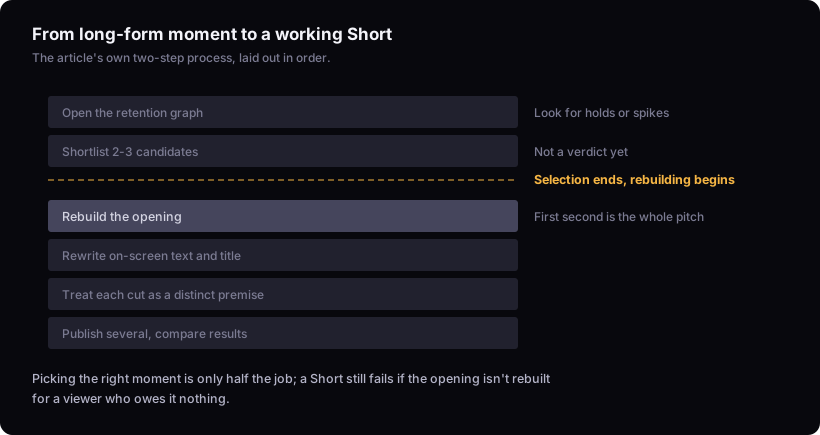
This is a starting point, not a verdict. A moment that held attention in context did so partly because of that context, which is exactly what a Short strips away. Use the retention graph to shortlist two or three candidates, not to declare a winner. If you haven't pulled up how to read your youtube retention graph, that's the place to learn what a hold versus a spike versus a slow climb actually means before you start marking timestamps.
If you want the timestamps without scrubbing manually, the video teardown surfaces the retention shape alongside the moments in the video, and the transcripts tool gets you the exact wording at each candidate point so you're not re-transcribing by ear.
Re-hook the clip: what has to change in the first second
A clip pulled from a long video almost always needs a new opening, because the Short has no preceding minutes to lean on. In the original, the viewer already knows who you are, what the video is about, and why this moment matters. In the Short, none of that exists — the first frame and the first line of on-screen text are the entire pitch.
This means the clip is raw material, not a finished asset. You are re-cutting the moment so the payoff or premise is stated immediately, the same job a cold open does for any video that has to hook a stranger in the first few seconds. If you're not sure what that first second needs to do structurally, how to hook viewers in the first 30 seconds covers the mechanics that also apply here, just compressed into a fraction of the time.
The on-screen text and title need the same rebuild, not a copy-paste of the long video's title. The long video's title was written to win a thumbnail-and-title decision in a feed where the viewer is comparing several options. A Short's opening text has a different job: it has under a second to convince someone mid-scroll that this specific clip is worth stopping for, which is closer to what the youtube hook formula: six archetypes and how to pick one is describing than to a standard video title.
One video, several Shorts: avoiding the duplicate-premise trap
A single long video usually contains more than one moment worth cutting, but that doesn't mean cutting the same "best" moment five different ways counts as five separate tests. If all five Shorts are built around the same beat with a different edit or a different opening line, a flop or a hit tells you about that one moment, not about five distinct ideas.
The more useful approach is to treat each Short as a genuinely different premise pulled from the source video — a different story beat, a different claim, a different piece of the argument — so that what you learn from publishing several of them actually adds up to something. Cutting the same peak five times and calling it five data points is the version of this that quietly wastes the upload slots.
There's no fixed count of how many Shorts one video can support. It depends on how many distinct moments the retention graph actually points to, and a video with one strong ten-second spike and a flat rest of the curve may only support one honest Short, not five.
How Shorts get discovered versus long-form
Long-form video distribution runs substantially on matching a video to what a viewer is already searching for or likely to watch next, which is why title, thumbnail and topic clarity carry so much weight for that format. Shorts sit in a feed built around fast, continuous consumption, where the signal that matters most is whether the viewer keeps watching and rewatches, not whether the topic matched a search intent.
This is exactly why a clip that would work as a long-form thumbnail-and-title combination can still fail as a Short: the two formats are answering different questions about the same piece of content. If your Shorts specifically aren't landing despite reasonable source material, why your youtube shorts aren't getting views goes into what tends to separate a Short that gets rewatched from one that doesn't.
None of this means long-form principles are irrelevant to Shorts — clarity about what the viewer is about to see still matters, the way it matters for how to write youtube titles that get clicks — but the ranking mechanics pulling a Short into more feeds are not the same mechanics that get a long video suggested.
What this method won't tell you
This process helps you find which moments in a long video are worth extracting and gives you a way to rebuild the opening so the clip can stand on its own. It does not tell you which specific Short will perform once it's published. Execution, thumbnail-equivalent framing, the exact wording of the on-screen text, and whatever the platform's ranking is doing that day all sit outside this process, and none of them are things a retention graph from the source video can predict.
It also isn't a substitute for publishing more than one Short from the same video and comparing what happens. A single clip, however carefully chosen and re-hooked, is one data point. If you're trying to work out whether a moment or a format is worth repeating, that judgement comes from watching what a handful of genuinely different cuts do, not from how confident the selection process felt going in. It's also worth checking average view duration on youtube: what it actually measures once your Shorts are live — the way that number behaves in a Short is a different read than it is for a long video, and it's easy to misjudge if you're carrying long-form assumptions into it.