Open by stating the premise in the first sentence, not building up to it, then hold back one thing the viewer wants — an answer, a result, an outcome — so there's a reason to keep watching. That's the mechanical core of a working opening. Everything else in this article is about which version of that you need, because "boring" and "confusing" are different failures and they don't share a fix.
No single line works for every premise, but the first move is always the same: state what the video is about in plain terms, then cut everything before it. What happens to the rest of the sentence depends on the premise. If your video is a comparison, the sentence names the two things being compared and says a winner exists without naming it — "one of these lasted three times as long as the other, and it's not the one you'd guess." If it's a transformation, the sentence shows the stakes of the after without showing the after — "this room was unusable a week ago." If it's a warning, the sentence names the consequence category without the specific outcome — "this mistake cost me the whole project." In each case the sentence names the question out loud and withholds only the answer — naming it is what keeps the gap concrete instead of vague.
State the premise, then withhold the payoff
The first 30 seconds has one job: make the premise unmistakable immediately, and make sure something in it hasn't paid off yet. Not a countdown, not a cold open by rule — those are shapes the premise sometimes takes, not the requirement itself.
"Unmistakable immediately" means the viewer knows what they're watching within the first sentence or two, not after a setup. If your opening explains context before it states what the video is actually about, you're asking for patience the viewer hasn't agreed to give yet. Say the thing first. Explain it after.
"Hasn't paid off yet" means there's a gap open in the viewer's head — a question raised on screen, a result shown before the process that produced it, a choice stated without its outcome. A viewer keeps watching to close that gap. If the opening answers everything it raises, there's nothing left pulling them to second 31.
Those two jobs pull against each other a little, which is why the three sentence shapes above are starting points to adapt, not blanks to fill. A video that's mostly comparison ("X vs Y") withholds the winner. A video that's mostly transformation withholds the after. A video that's a warning withholds the consequence. The premise decides what's being withheld; the shapes only hand you a first draft of the sentence. The youtube hook formula goes deeper on these shapes if your premise doesn't fit comparison, transformation, or warning; writing the opening covers wording the sentence once you know what you're withholding.
Check whether the opening is actually the problem
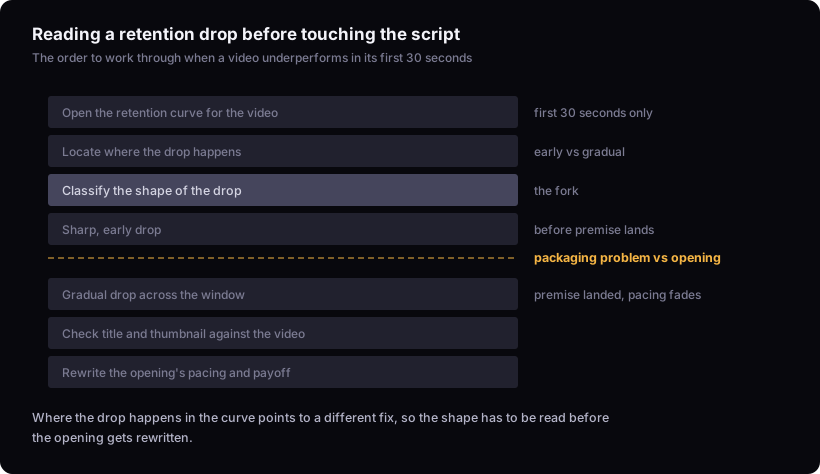
Before you rewrite anything, look at where viewers are leaving. Audience retention shows a percentage of viewers remaining at each second. A steep drop concentrated in the first 5-10 seconds reads differently from one spread evenly across the full 30, and the two point at different fixes.
A drop that's sharp and early — most of the loss gone in the first two or three seconds, faster than anyone could weigh even a premise-first opening — points away from the script and toward the packaging. Run the cold-read check in the next section: if the video isn't what the click promised, the viewer decided to leave before your carefully built gap had a chance to open, and no opening line fixes that, because the line isn't the thing that's broken.
A drop that's gradual across the full 30 seconds, with viewers who stay past second 5 but trail off steadily, can mean the premise landed but the gap you opened wasn't stated clearly enough to hold attention — the question was implied rather than asked out loud, so there was nothing concrete left pulling the viewer forward. That's worth checking on the opening itself: does the sentence state the question whose answer you're withholding, or just gesture at it.
Treat the shape of the curve as a place to look, not a verdict — it narrows where to check, it doesn't confirm what's wrong.
When the problem started before the video did
The check here happens away from the script entirely: read your own title and thumbnail as if you'd never seen the video, ideally by having someone else read just the title and thumbnail and tell you what they expect the video to be about. Compare that against what the opening actually delivers in the first few seconds — the same thing, or something adjacent to it? If it's adjacent, the fix is the title or thumbnail, not another line of dialogue. How to write youtube titles that get clicks covers building a title that states its premise honestly; when that cold read disagrees with what the opening delivers and the curve drops early, start the repair at the title, not the hook.
Testing whether your opening style is actually working
One video with strong retention proves less than it feels like it proves. A viewer's day, a lucky topic, a recommendation surge you can't see the cause of — any of those can produce one good curve. Before treating a retention shape as evidence that a particular opening style works, look for it repeating.
There's no fixed number of videos that proves a pattern is real, but independence matters more than count — one format working across videos on one channel only shows that channel's audience likes it, not that the format itself is doing the work. Check the failures too: an opening style only means something if similar videos without it did worse. Watching one success and ignoring the misses is how a coincidence gets mistaken for a method. If you're one video in, treat this as a hypothesis to carry into your next few uploads, not a verdict on tonight's script.
If a video did unusually well and you're tempted to credit the opening, weigh that against the channel's own normal range first. A view count is only meaningful relative to what that channel usually gets — a video several times its channel's typical performance is worth learning from, while the same raw number could be an ordinary result on a bigger channel. What is an outlier video on youtube? covers judging a result against a channel's own baseline before crediting any one choice for it.
What retention data can't tell you
Retention shows where a viewer stopped watching. It does not show why. A drop at second 8 could be confusion, boredom, a notification, or a viewer who opened the wrong video and left the moment they realized it — the curve looks the same in every case.
This method can point you toward the likely category of problem and where to look next — the shape of the drop, early versus gradual, is a real signal. It cannot confirm the actual cause. That confirmation still needs a judgement call: reading the title and thumbnail honestly, watching your own opening as if seeing it cold, checking whether the pattern repeats. No dashboard makes that call for you.
Building and checking your next opening
Publish, then watch the first 30 seconds of the retention curve specifically — not the whole-video average — to see whether the drop, if there is one, is sharp and early or gradual across the window. That first curve is a data point to carry into the next upload, not a verdict on the style — the single-video warning above still applies.
The video teardown breaks down where in a video retention actually falls, section by section, if you want that read without doing it by eye. The transcripts tool pulls the exact wording of an opening for you to check against the premise it's supposed to state.
If the pattern repeats — same shape of drop, same kind of opening, across several videos and not just one — that's the point to trust it as your style rather than a one-off.