A hook formula is a named opening structure you choose deliberately, rather than a line you write until it sounds good. There are six that cover almost every video, and one sharpening technique — the contrast formula — that improves any of them.
The reason to work this way is not that named structures are magic. It is that a named structure can be judged, argued with, and swapped for a different one next time. "Write a compelling hook" gives you nothing to change when the video underperforms.
Why most YouTube hook formulas are unusable
Search this topic and you will find the same three instructions: grab attention in the first five seconds, create curiosity, get to the point. All true. None of them tell you what to type.
The gap is that attention-grabbing is an outcome, not a method. Two openings can both "create curiosity" and work through completely different mechanisms — one by withholding a result, another by contradicting something you already believe. When the video flops, "create curiosity" cannot tell you which lever to pull, because it never named a lever.
So the useful version of this question is not how do I hook people. It is which of the small number of opening structures fits this specific video.
The six hook archetypes
These are the six the PublishBench hook writer works from. Each has a persona attached, because the same words land differently depending on whether you are positioned as a peer or an authority.
| Archetype | You sound like | Use it when | The trap |
|---|---|---|---|
| The Fortuneteller | A trend-spotter | Something in the subject is genuinely shifting | The promise is checkable, and viewers check it |
| The Experimenter | A peer, not a guru | You actually ran the thing | Requires you to have done it. No exceptions |
| The Teacher | An expert | You have researched a specific case | You have to be right about the case |
| The Magician | A demonstrator | There is something visual in frame | Rarely a whole hook — stack it in front of another |
| The Investigator | An insider | You have a genuinely non-obvious fact | If they already know it, it reads as condescension |
| The Contrarian | Someone with a position | You disagree with the standard advice | You now have to defend it for a whole video |
What each one sounds like in practice:
1. The Fortuneteller. Paint how something is about to change.
"This new feature is going to completely change how small channels get discovered. Here's why."
2. The Experimenter. You had a problem, you tried a method, here is what happened.
"I rewrote the first fifteen seconds of my last six videos. Here's what changed."
The most trust-generating of the six and the most dangerous. An invented experiment is the fastest way to lose an audience that can check, and this one is checkable.
3. The Teacher. Break down someone else's playbook as a case study.
"This channel went from 400 views to 90,000 on one format change. Here's the change."
4. The Magician. A direct command pointed at something on screen.
"Look at this thumbnail right here. That's the reason this video did 4x."
Use it as a stacking move — stop the scroll, then hand off to another archetype within a few seconds.
5. The Investigator. Reveal something most people do not know.
"There's a report inside your own analytics that almost nobody opens, and it answers the question you've been guessing at for months."
6. The Contrarian. State a belief against the common one, immediately.
"Everyone will tell you to post more often. For most channels under 10,000 subscribers that is the worst possible advice."
The contrast formula
This is not a seventh archetype. It is a sharpening pass that works on any of the six, and it is the single technique most worth learning.
Three steps:
- Pick your premise. What the video is actually about.
- Name the common belief. What most people assume about it.
- State your contrasting take. Where you disagree, and what is true instead.
Watch what it does to the same idea.
Flat: "Thumbnails are important for getting clicks."
That is a premise with no belief and no contrast. Nobody disagrees, so there is no reason to keep watching.
Sharpened: "Everyone treats the thumbnail as the last thing you make. That is exactly backwards — if you design it first, it tells you whether the video is worth making at all."
Same subject. Now there is a claim, an opponent, and a reason to stay. The contrast formula is what turns a topic into an argument, and arguments hold attention that topics do not.
One warning: the contrast has to be real. If you manufacture a "common belief" nobody actually holds so you can knock it down, viewers feel the setup. Attack a belief your audience genuinely has, including one you used to hold yourself.
Choosing between them
Work through these in order.
Did you personally do the thing? If yes, the Experimenter is almost always strongest, because firsthand beats researched. If no, it is off the table entirely.
Do you have a specific case, with numbers? Then the Teacher.
Do you disagree with the standard advice on this topic? Then the Contrarian, sharpened with the contrast formula.
Is there something visual in the first frame? Stack the Magician in front of whichever you picked.
Is the subject genuinely changing right now? The Fortuneteller — but only if it is, because this one dates badly.
None of the above? The Investigator, if you have a non-obvious fact. If you do not have one of those either, that is worth paying attention to: it usually means the video does not yet have an angle, and no opening line will fix that.
Archetype and mechanism are not the same thing
Worth separating, because the words get used interchangeably and they operate at different levels.
The archetype is who you are being: a peer reporting an experiment, an expert breaking down a case, someone with an unpopular opinion. It decides the stance of the whole video, not just the first line.
The mechanism is the rhetorical device the sentence itself runs on. An open loop. A contradiction. Named stakes. A direct promise. A question.
One archetype can be delivered through several mechanisms. A Contrarian hook usually runs on contradiction, but it can just as easily run on stakes — "posting more often is the fastest way to quit in six months" is Contrarian in stance and stakes in mechanism.
This matters when you go to test. Changing the archetype is a different experiment from changing the mechanism, and if you change both at once you learn nothing from either.
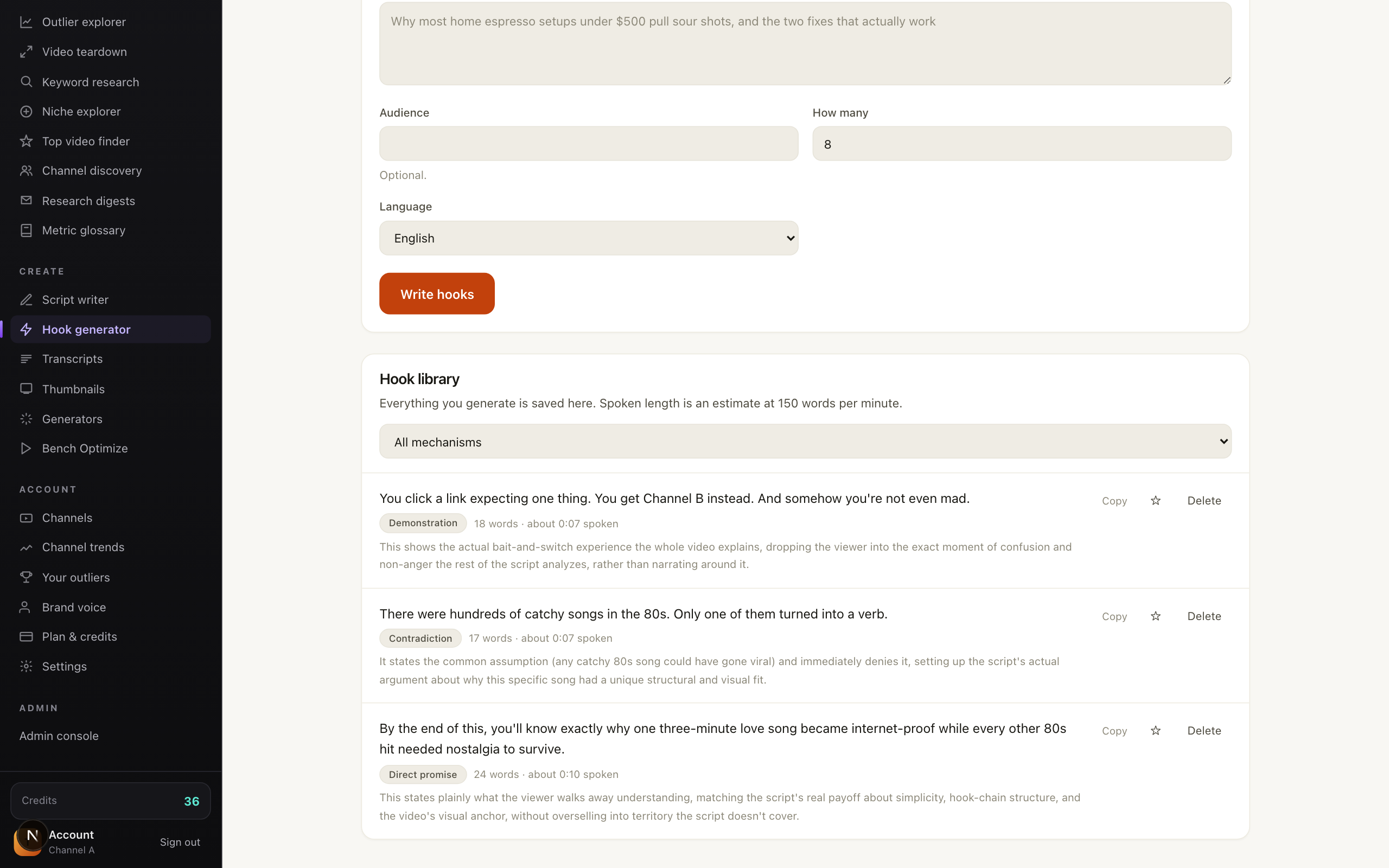
It also matters for reading what a tool hands you. PublishBench labels each hook with its mechanism — stakes, contradiction, direct promise, question and so on — rather than its archetype. The archetypes are the frame it writes from; the mechanism is what gets printed next to the line.
What a working hook has to do, and how they fail
Before you record, check the opening against these. They are the criteria the hook writer validates against.
- Opens a curiosity gap inside about five seconds.
- Gives enough context immediately that the viewer knows what the video is about. Confused is not the same as curious, and confused people leave.
- Contains actual tension. A flat true statement is not a hook.
- Escalates quickly rather than winding up. Drop into the middle of the story, not the beginning.
- Can be paid off by the body. A hook the video cannot deliver on costs you more than a dull one.
- Matches the title and thumbnail. If the packaging promises one video and the first line starts another, the viewer feels the mismatch before they can name it.
- Runs in one breath, roughly fifteen words or fewer for the opening line.
The four ways hooks fail
Starting at zero. "Hey guys, welcome back to the channel." You have spent your most valuable seconds on a greeting.
Announcing instead of hooking. "Today I'm going to talk about thumbnails" describes the video rather than opening it. Announcements release tension; hooks create it.
Bait and switch. The hook promises something the body never delivers. This works once per viewer.
Writing one hook. The most common mistake and the easiest to fix. A single opening is one guess. Draft several across different archetypes and you can actually compare mechanisms rather than polish a sentence.
Where this method stops working
A hook cannot rescue a video nobody wanted. If the topic has no audience, a stronger opening raises the drop-off that follows it rather than fixing anything — you have brought more people to the point where they leave.
The method also does not tell you which archetype suits your audience. That is a judgement about your channel and your viewers, and no formula makes it for you. What the archetypes give you is the ability to notice which one you used, so that when something works you can tell what worked.
And these are craft frameworks, not measurements. They come from patterns creators teach publicly and from how experienced writers actually construct openings. They are not a published study, and this article does not present them as one. Where PublishBench shows a measured figure about a video or a channel, it comes from the YouTube API and is labelled where it appears — how our data works.
Doing this on your own next video
Write the premise in one sentence, run it through the contrast formula, and read your drafts out loud — a hook that works on the page and not in the mouth is not a hook.
If you would rather not do it by hand, PublishBench's hook writer drafts several openings at once, labels each with the mechanism it uses, and explains what that mechanism is doing — so you can judge the device instead of the vibe, and deliberately test a different one next time. It will not rank them by predicted performance, because that is not knowable before you publish.
The six archetypes and the rest of the method are on the writing the opening page.