Shorts views don't respond to the same levers as long-form views, because the feed that decides who sees a Short is built around swiping, not clicking. A thumbnail persuades someone scrolling a grid of options. A Short has no grid moment — it's already playing, full screen, before the viewer has decided anything. That single structural difference is why so much long-form advice fails to move the needle on Shorts, and it's the argument this article makes.
Why long-form growth tactics don't carry over to Shorts
Thumbnail and title optimisation exist to win a decision that happens in browse and search results: which of ten options do I click. Shorts mostly skip that decision. The viewer is dropped into a video already playing, and their only choice is whether to keep watching or swipe to the next one. There's no comparison against nine other thumbnails, so the psychology that makes a thumbnail work — contrast, curiosity, a face mid-reaction — doesn't get the chance to operate. Curiosity-gap titles have the same problem: the gap needs a moment of consideration to work, and a swipe feed doesn't give the viewer one.
This doesn't mean packaging is irrelevant everywhere on YouTube. It's still central for long-form, where how to write youtube titles that get clicks and thumbnail choices genuinely decide click-through. It means the two formats are solving different problems, and treating Shorts as "a small long-form video" misapplies a whole toolkit built for a different moment.
The sub-second hook: what has to happen before anyone decides to stay
The window to stop someone swiping away is compressed to a fraction of a second, and it's decided by what's visually happening on screen, not by what's said. There's no time for a spoken setup or a slow zoom-in. The first frame needs motion, a visual anomaly, or something mid-action that the eye can't immediately parse — because parsing it is what keeps the thumb off the screen.
This is a different skill from writing a long-form hook, where you have several seconds and a sentence or two to earn attention. The method behind that longer version — naming the mechanism, structuring the setup — is covered in the youtube hook formula: six archetypes and how to pick one, and the underlying craft of writing an opening is at writing the opening. Both are worth understanding even for Shorts, but apply the compressed version: assume you have a beat, not a sentence.
Loopability and full-watch behaviour as the real retention currency
Long-form retention is judged against a curve — you're looking for where viewers drop and trying to flatten the slope. Shorts retention works differently: the meaningful outcome looks close to a complete watch-through, often followed by a replay, because the video loops automatically when it ends. A Short edited to land its last frame back into its first frame gives the viewer nothing to notice as an ending, so the loop continues and the watch time compounds without the viewer doing anything.
That changes what you're editing for. A narrative arc with a beginning, middle and payoff pacing is long-form thinking. A Short benefits more from being edited as a closed loop — cut so the last visual beat reconnects to the first, so a rewatch feels like one continuous piece rather than a repeat. This is a genuinely different edit than trimming a long-form video down to sixty seconds.
Does posting volume actually move the needle?
Posting more Shorts doesn't guarantee more reach, but there's a plausible mechanical reason consistency correlates with better results anyway: a feed that samples new content against a wider pool of comparable videos needs enough of your content in that pool to sample from. One Short is a single data point the system can test against viewers. A steady stream gives it more chances to find which one resonates and push it further.
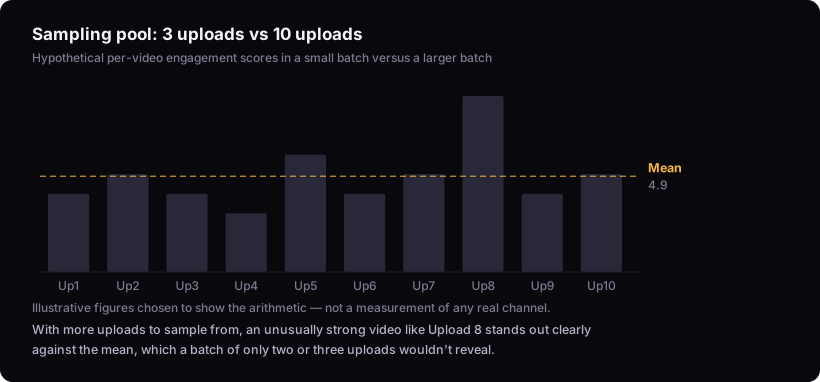
That's an inference from how sampling-based recommendation systems generally behave, not a guarantee, and it isn't the same claim as "more uploads always equals more views." A high volume of Shorts that all swipe away identically will get sampled and rejected identically. Volume without loopability or a working opening doesn't compensate — it just produces more videos that get swiped past quickly. If your long-form output is also stalling and you're trying to work out whether the problem is frequency or something else entirely, why your youtube videos aren't getting views covers the diagnostic questions to ask before changing your posting cadence.
What titles, text overlays and captions are actually doing
Titles and on-screen text still do something on Shorts, but it's a search and accessibility job, not a persuasion job. Someone searching YouTube or typing a query into a search engine can still land on a Short through its title text, and on-screen captions help viewers who watch on mute — a large share of scroll-feed viewing happens that way. Neither of these is the click-decision job a long-form title does at writing the title, where the words themselves have to win a comparison against other results.
Practically: keep titles and overlay text accurate and legible, because they still carry discovery and comprehension weight. Don't spend the same effort engineering curiosity gaps or A/B testing title phrasing that you'd spend on a long-form upload — that effort is better spent on the opening frame and the loop, where the swipe decision actually happens.
Where this advice runs out
None of this comes from measuring Shorts performance directly. It's reasoned from how a swipe-based, autoplay-and-loop feed structurally has to work, combined with what platform and creator commentary has said publicly about hooks, loops and posting frequency. Nobody outside YouTube can see the actual weighting the Shorts feed gives to hook speed, loop completion, or upload consistency, and that weighting isn't published anywhere this article can cite.
Results will vary by niche, by how established the channel already is, and by factors specific to an individual account's watch history that no outside method can see. This isn't a tested formula and it doesn't promise a view count, a growth rate, or a particular outcome. It's a structural explanation of why long-form tactics underperform on Shorts, offered so you can stop spending effort on packaging that isn't doing the job you think it's doing.
If you want to see how a video is actually performing against your own channel's baseline rather than guessing from a swipe theory, what is an outlier video on youtube? explains how that comparison works, and how our data works lays out the arithmetic behind it.