Studying one viral video and trying to extract "what worked" is the wrong unit of analysis: alone, it can only tell you what happened, not why. Without a control group, you're doing admiration, not analysis.
This article walks through that process in order: confirm the video is a real outlier, separate the click from the watch, judge the packaging, read what retention is available, then build the control group that tells you whether the traits you noticed actually caused the result.
Confirm it's actually an outlier before you study it
The first check is against the channel's own recent baseline, not against your own or against YouTube in general — a 40,000-view video is a huge result for one channel and an off day for another. If you skip this step you risk spending an afternoon reverse-engineering a video that simply belongs to a bigger channel's typical size, not to anything unusual that channel did.
We treat roughly three times a channel's recent normal as the point where a video counts as a real outlier, with higher multiples signalling a stronger result. Treat that line as a starting point to tune to your own niche, not a fixed rule — but pick a line and hold to it before you start studying a video, rather than deciding case by case. Establish "recent normal" like this: take the channel's last 10 uploads (or all of them if the channel has fewer), drop the video you're studying and drop the single highest performer left, and treat the median of the rest as the baseline — excluding Shorts if the video you're studying is a long-form upload. For a fuller definition of what counts, see what is an outlier video on youtube?
Separate the click from the watch
A viral video succeeds at two different jobs, and confusing them is the single most common mistake in this kind of teardown. The title and thumbnail earn the impression click — someone scrolling a feed decides to tap. The hook, pacing and structure earn the watch — someone who already clicked decides to stay. These are different pieces of evidence and they answer different questions, so analyse them separately.
If you only look at total views and retention average, you'll end up crediting the thumbnail for something the hook actually did, or blaming the title for a drop that happened ninety seconds in. Checking youtube impressions vs views: what the pair actually tells you is the fastest way to see whether a video's strength was getting clicked or getting watched, and what is a good click-through rate on youtube? explains why that number resists a single universal target.
Read the thumbnail and title as a single decision
A title and thumbnail work as one decision, not two separate pieces of copy, because a viewer processes them together in the time it takes to scroll past. Judge them together, not the title as a headline and the thumbnail as an image.
The fastest test is to view the thumbnail at actual feed size, on a phone, and give it under a second. In that time you should know where your eye is meant to go and understand the visual premise. Because you already know the video went viral, don't grade this from memory: show the thumbnail to someone unfamiliar with it, or scroll it past yourself mixed in with a few unrelated thumbnails, and see if they can name the subject in that time. If they can't, that's a fail worth recording before you move to the next check — that's the test we use, because a feed only gives a thumbnail about a second of real attention, so the check should match the conditions the thumbnail actually faces. If you have to stop and study it, the thumbnail has a complexity problem, not a taste problem.
For the title, the pattern we look for is clarity plus curiosity — the premise stated plainly, with one specific thing withheld. A concrete way to check: write down what you think the video is about after reading only the title, and write down what question it leaves unanswered. By the clarity-plus-curiosity standard we trust most, a title you can't name a specific withheld thing in — or one that needed the thumbnail to make its premise land — is carrying less weight than it looks like it is. Run the viral video's title and thumbnail through both checks before moving on. A fail here doesn't prove the win came from elsewhere on its own, but it tells you not to credit the packaging until the control group confirms it — so note the result and keep going.
Use the retention graph to find where the hook actually worked
Where a channel's retention data is visible, the retention graph can point to the moment the hook delivered or lost its promise. Look at the first 30 seconds specifically: a flat or rising line means the opening delivered on what the title and thumbnail promised. A sharp drop at a specific second tells you where the promise likely broke — a slow setup, a mismatch between the thumbnail's premise and the actual opening line, or a delayed payoff — though confirming it's that trait and not something else the video also did still requires the control group.
This is where "the hook was strong" turns into a timestamp and a mechanism you can actually describe and test. How to read your youtube retention graph covers how to read the shape of that curve in more detail, and how to hook viewers in the first 30 seconds covers what to do with what you find. If the channel's retention data isn't visible to you — which is normal, since it's rarely public — you're limited to inference from structure: how long before the video states its premise (the first line or scene where the topic is unambiguous, timed by scrubbing the video's timeline), and how long before it shows anything visually distinct from the thumbnail. Compare those two timestamps against the same measurements on your control group's videos — if the outlier states its premise noticeably sooner, that gap is worth treating as a candidate cause, not the retention shape itself, since you can't see that.
Build a control group before you trust the pattern
The fix is a control group: several similar videos, ideally on the same or comparable channels, that used a similar approach and did not go viral. Pick the comparison videos for similarity of topic, format and channel size, without pre-filtering for the trait you suspect mattered. Then check whether they happen to share that trait anyway: if they do, it probably wasn't the cause; if they don't, you have a real comparison.
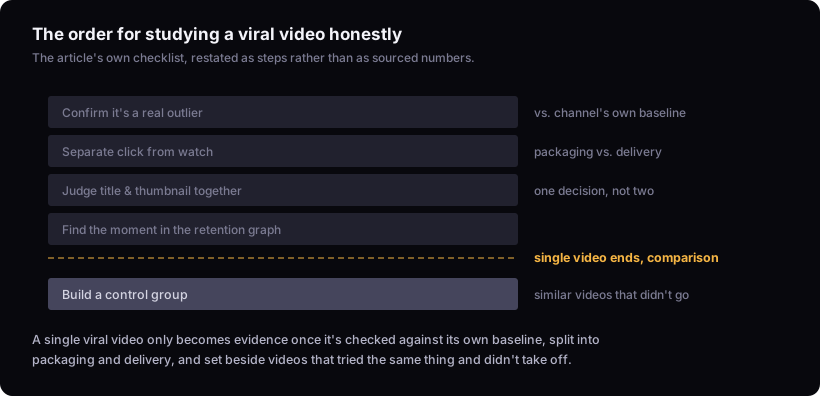
This is survivorship bias, and checking the failures is how we avoid it. Finding that control group is the hardest step, because the non-viral videos it requires don't surface in search or browse the way the outlier did. Start with the same channel's upload history for videos on the same topic or format — that catalogue is at least visible. For the cross-channel case, the practical options are narrower: check channels you already track, or pull from a handful of similar-sized channels in the niche whose upload history you can browse directly. There's no reliable shortcut for surfacing flops outside a channel you already have access to. How to tell if a youtube video format is worth copying walks through building that comparison set in more detail.
Decide how many outliers you need before copying anything
A single outlier is a data point, not a pattern, and copying it as if it were a formula is the fastest way to rebuild a strategy around noise. Three independent outliers is enough to get our attention; five or more, spread across several different channels, is where we start treating a shared trait as worth testing — provided each of those outliers has also cleared the control-group check, since the count alone is the same survivorship-bias trap the comparison step exists to catch. Independence across channels matters more than the raw count: one channel repeating a format only proves that one audience likes it, not that the format itself works elsewhere.
Once you have that many confirmed outliers, the pattern becomes something to test on your own next video: try the shared title structure, the shared thumbnail approach, or the shared hook timing, and treat the result as one more data point rather than a certainty.
What this kind of teardown cannot tell you
A teardown built from public signals only — title, thumbnail, description, and retention shape where you can see it — has real limits, and stating them plainly is part of doing the analysis honestly. It cannot show whether a video's traffic came from search or from suggested/browse, because that split isn't visible outside the uploader's own account. It cannot account for personalisation, since two viewers can see the same video recommended for entirely different reasons based on their own watch history. And it cannot prove causation — matching patterns across outliers and control videos builds a hypothesis, not a proof.
Nobody outside the platform knows exactly what gets a youtube video recommended, and no external teardown changes that. Treat every pattern this method surfaces as something worth testing on your own channel, not something to trust outright. The video teardown tool can help pull the comparison pieces together, but the judgement about what the pattern means is still yours to make and yours to test.