An outlier is a video that got far more views than the channel that published it normally gets. It is a ratio, not a view count — a video with 40,000 views is an outlier on a channel that usually does 5,000, and unremarkable on a channel that usually does 200,000.
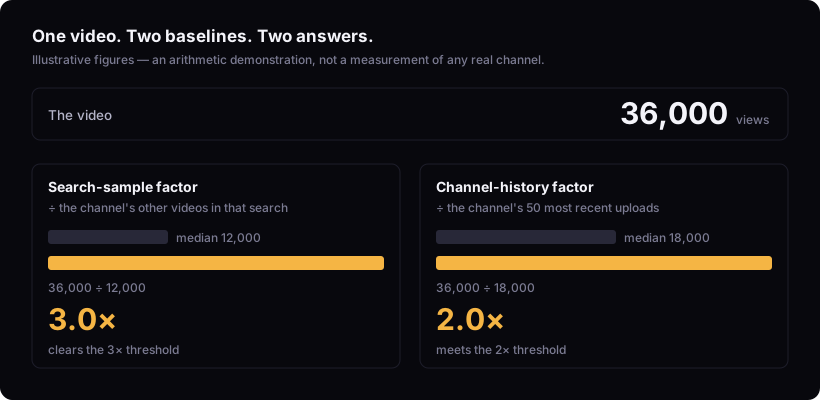
That much is agreed everywhere. What almost nobody tells you is that there are two different ways to calculate it, they use different denominators, and they routinely disagree about the same video.
| Search-sample outlier factor | Channel-history outlier factor | |
|---|---|---|
| Divided by | The median of that channel's other videos in the same search | The median of that channel's own recent uploads |
| Question it answers | Within this topic, did this beat the channel's other work on this topic? | Against everything this channel does, was this unusual? |
| What's in the sample | Whatever that one search happened to return | The channel's 50 most recent uploads in that format |
| Minimum before it reports | 3 videos from that channel | 5 uploads, each at least 14 days old |
| Outlier threshold | 3× | 2× |
| Shorts and long-form | Not separated — the search decides the sample | Measured separately, never averaged |
| Where you see it | Keyword research, top videos, outlier explorer | Channel watchlist, your own scoreboard |
What an outlier video actually measures
Every outlier figure is the same division:
outlier factor = this video's views ÷ a baselineThe baseline is the entire argument, and the two in common use pick different ones.
Search-sample outlier factor
Views divided by the median views of the other videos by that same channel that came back in the same search.
This is what you are looking at in a keyword research tool or a topic-based outlier feed. It answers: within this topic, did this video overperform the channel's other work on this topic?
PublishBench requires at least three videos from that channel in the result set before reporting a factor at all — below that you are dividing by one or two videos, which is not a median. The default threshold for calling something an outlier here is 3×.
The catch is built into the definition: the baseline is whatever the search happened to return. Run a different query, get a different denominator, get a different factor for the same video. Both are correct for their own sample.
Channel-history outlier factor
Views divided by the median views of the channel's own recent uploads, regardless of topic.
This answers a different question: against everything this channel normally does, was this unusual? It is the figure a watchlist or a personal scoreboard shows.
PublishBench uses the channel's 50 most recent uploads. A channel needs at least 5 uploads in that format, each at least 14 days old, before any factor appears. Anything at or above 2× is flagged.
They are not interchangeable
A video can easily be a strong outlier on one measure and unremarkable on the other. A channel that mostly posts about one thing and occasionally posts about another will produce exactly that: the off-topic video looks enormous against a search sample of three, and ordinary against fifty uploads.
If a tool shows you an outlier number without telling you what it divided by, you cannot tell which question it answered.
What counts, and what doesn't
A video with no factor is not a video with a low factor. The most common misreading. When a channel does not have enough qualifying uploads, the honest output is nothing — not a zero, and not a 1×. Absence means the baseline could not be established.
A very new video is not yet judgeable. This is why the 14-day maturity rule exists. A video published yesterday has not finished accumulating the views it is going to get, so comparing it against settled videos measures its age, not its performance.
A very high factor is usually a statement about the denominator. Past roughly 15×, the number more often means the channel's median is unusually low — a dormant channel, a format change, a channel that posted ten test videos — than that the video did something extraordinary. The interesting range is the low multiples, where something repeatable probably happened.
Shorts and long-form are different populations. A Short measured against a long-form baseline tells you nothing except that Shorts get more views. PublishBench counts anything 180 seconds or under as a Short and never averages the two. A video whose duration YouTube has not reported gets no format, and therefore no baseline.
Why it matters for your channel
An outlier is the only signal available that separates the topic worked from the channel is big. A 3× on a channel your size tells you something specific happened — a topic, an angle, a packaging decision — that is worth understanding.
It is also the only view-based signal you can compute about someone else's channel, because it needs nothing but public view counts. Retention, CTR and impressions are all locked inside the owner's analytics. The outlier factor is the one measure of "did this work" that is visible from outside.
What it can't tell you
It cannot tell you why. This is the whole limitation and it is not a small one. The factor is arithmetic over view counts. Whether the video overperformed because of the topic, the title, the thumbnail, the timing, an external link, a shout-out, or the algorithm having a strange week is not in the data. Any tool that reports a cause is guessing, and PublishBench deliberately does not.
It is not a prediction. That a topic produced an outlier once is not evidence it will again, for you, on your channel, with your audience.
It cannot see traffic source. A video that went outlier because someone posted it to a large subreddit looks identical to one that earned it through browse.
It has no view of the channel's intent. A deliberate experiment and an accident produce the same number.
Finding them
If you want to compute this by hand: take a channel's recent uploads in one format, find the median view count, and divide each video by it. The median rather than the mean, because one runaway video drags an average upward and hides everything else.
PublishBench's outlier explorer does it across everything the platform has already researched, and prints the video and channel count above the results so you can see the size of what you are searching. It costs no credits, and it covers a rolling 30-day window rather than all of YouTube — which is a real limit, and it is stated on the page rather than in a footnote.
Both factors are defined, with their baselines and their limits, in the metric glossary, and the arithmetic behind every threshold is at how our data works. Both are public, so you can check the definitions before deciding whether the tool is worth an account.