Search ranking and suggested videos are two different systems
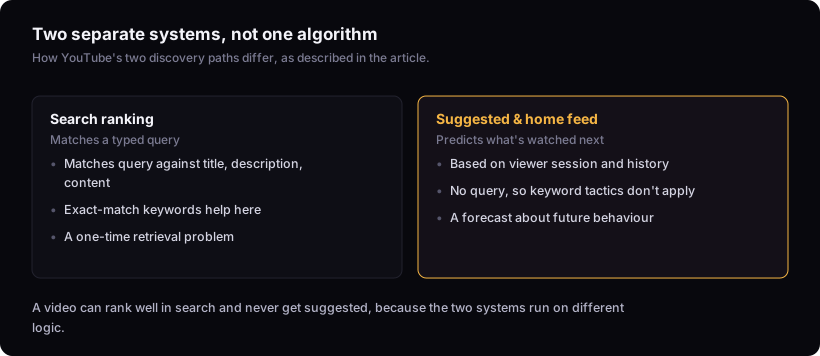
Two things get a video recommended into the suggested column or home feed: packaging strong enough to earn a click when it's shown, and a viewing experience strong enough that the person watching it stays on the video and on YouTube afterward. Everything else — tags, upload time, hashtags — is noise YouTube has explicitly ruled out. That's a separate question from ranking in search results for a typed query, which matches title, description and content against the query itself. Conflating the two is why so much advice about "the algorithm" doesn't hold up: a tactic that helps a video get found by search (matching a query) doesn't do anything for a video's odds of being suggested when nobody typed anything.
This distinction matters because tactics that help with search — exact-match keywords in a title, for instance — do nothing for suggested placement, since there's no query to match against. A video can rank well in search and never get suggested, or the reverse. Treating them as one problem with one fix is the first mistake most "how to get recommended" advice makes.
What YouTube's documentation actually credits for discovery
YouTube's own creator-facing documentation credits four things with affecting discovery: (1) the title, (2) the thumbnail, (3) the description, and (4) how well the video's actual content matches what those three promise once someone clicks. The first two determine whether a shown video gets clicked; the third helps search and topic-matching; the fourth determines whether that click gets rewarded with continued suggestion. Thumbnail and title do the job of getting a viewer to click once a video is shown to them; description and content matching help search and topic classification. None of this is secret — it's published, and it's also the boring half of the answer, because it's about packaging quality, not a trick.
Tags are the clearest case where the documentation contradicts folk belief. YouTube has stated tags play a minor role, mostly useful for correcting common misspellings of a word in your video's title, not for surfacing a video to a new audience. A video with fifty carefully researched tags and a weak thumbnail will lose to a video with no tags and a strong one — the hour spent on tags is better spent testing a second thumbnail concept against the first. If you want the fuller breakdown of what tags do and don't do, see do YouTube tags still matter? what they actually do now. Upload time and hashtags sit in the same category: neither appears in YouTube's stated criteria for either search or suggested placement.
Impressions and CTR: the lever that actually moves suggestions
An impression is YouTube showing your thumbnail somewhere — home feed, suggested column, search results — and click-through rate is the share of those impressions that turn into a click. This is the first place a creator has real, direct control, because title and thumbnail are entirely yours to write and design.
YouTube does not publish a fixed number for what counts as a good CTR, and any figure you see quoted as universal is not coming from YouTube. CTR only means something compared against a video's own channel and topic, because audience size, niche and even video length change what's normal. For the full reasoning on why a single benchmark doesn't work, see what is a good click-through rate on YouTube? A high CTR relative to a channel's own baseline is a real signal that a topic connected. A raw CTR number compared across unrelated channels tells you close to nothing. It also helps to understand what an impression actually represents versus a view — see YouTube impressions vs views: what the pair actually tells you for that distinction.
Why retention after the click still decides whether recommendation continues
A click is not the finish line. If viewers click through and leave quickly, YouTube's suggestion system has evidence that the video didn't deliver on the thumbnail and title's promise, and continued suggestion tends to taper off. Recommendation is tied to session-level engagement — did this viewer keep watching, did they stay on YouTube afterward — not to a one-time metadata win at the point of the click.
This is why two videos on the same topic, with similarly strong thumbnails, can get very different recommendation reach. One holds attention past the point where the premise was stated; the other doesn't. The way to check this on your own video is to find the timestamp where the title or thumbnail's promise is actually delivered, then look at the retention graph at that same timestamp: a drop right there means the payoff didn't land where the viewer expected it. To see where your own drop-off happens, how to read your YouTube retention graph walks through reading that data on a real video. If a specific video is underperforming and you want to work through causes systematically, why your YouTube video isn't getting views: a diagnostic covers that separately from this article's scope.
Common tactics that don't hold up against YouTube's own explanation
A lot of circulating advice treats recommendation as a checklist rather than an outcome. Against YouTube's stated criteria, several popular tactics don't survive:
| Tactic | What YouTube's documentation says |
|---|---|
| Tag stuffing | Tags play a minor role, mainly for misspellings — not discovery |
| Posting at a specific "optimal" time | Not named as a ranking or suggestion factor |
| Hashtag spam in the description | Not named as a factor; irrelevant tags can work against a video |
| Exact-match keyword titles | Helps search matching only, does nothing for suggested placement |
| Uploading more often, regardless of quality | Not a stated factor either way |
The gap between these tactics and what's documented is exactly why polishing metadata alone rarely moves a video that isn't otherwise holding attention. The two things that are actually named — packaging and content match — sit upstream of everything else on this list.
What a creator can actually influence
Two things are directly in a creator's control: the packaging that earns the click, and the content that earns the watch. Concretely: write and test the title and thumbnail as a pair before upload rather than treating either as fixed once chosen, and check whether the video's opening delivers on the specific promise the title and thumbnail make — a title that promises "how" needs the how to start early, not after a long windup. Where a video loses attention, that gap between promised and delivered is the first thing to look at, not pacing in the abstract. Everything downstream — how often the video gets suggested, to whom, and how far it travels — is YouTube's system responding to how well those two things performed with a real audience.
That's a narrower list than most "get recommended" guides suggest, and it's narrower on purpose. For the mechanics of building a thumbnail that earns the click, see how to make a YouTube thumbnail that gets clicks, and for title construction see how to title a YouTube video (with working examples). Both sit inside the wider set of decisions covered at the rest of the upload page.
What this article can't tell you
This reasons from YouTube's published documentation on search and suggested videos, not from first-party testing or private performance data. It can point to the two levers documentation confirms — packaging and retention — and it can explain why two similar videos diverge in reach. What it can't do is assign a cause to one specific viewer's decision not to click or not to keep watching: that depends on personalisation and session context YouTube never discloses, and no outside analysis can recover it. What you can do is check the parts that are visible: your own CTR relative to your own baseline — a meaningful gap is one outside the normal spread of your last several uploads in the same format, not a one-off — and where your retention graph actually drops relative to the point where the title or thumbnail's promise gets paid off: a drop before that point points at the opening, a drop after it points at pacing later in the video.