An impression is counted when your thumbnail is shown to a viewer for long enough to plausibly register; a view is counted when someone actually watches. They measure two different stages of the same funnel, and neither one alone tells you whether a video is doing well. What tells you something is the ratio between them, and even that ratio has no universal target.
What YouTube counts as an impression
An impression is logged when a thumbnail is displayed on screen for a minimum duration, regardless of whether the viewer notices it, hovers over it, or scrolls straight past. It is a visibility event, not an engagement event. Nothing about the viewer's attention, interest, or intent is captured by the count itself — only that the thumbnail was on the screen long enough to have had a chance.
This matters because a huge stack of impressions can accumulate from a video sitting in a feed that nobody was looking at closely. The number tells you the thumbnail was served. It does not tell you the thumbnail was seen, read, or considered.
What YouTube counts as a view
A view is a separate, later event: someone clicked (or tapped) and the platform registered enough watch time to count it as a real view rather than an accidental click. Impressions happen before the click; views happen after it, and after a small amount of playback. They are not two names for the same moment — they are two different moments in the same sequence, separated by a decision the viewer makes in the space between them.
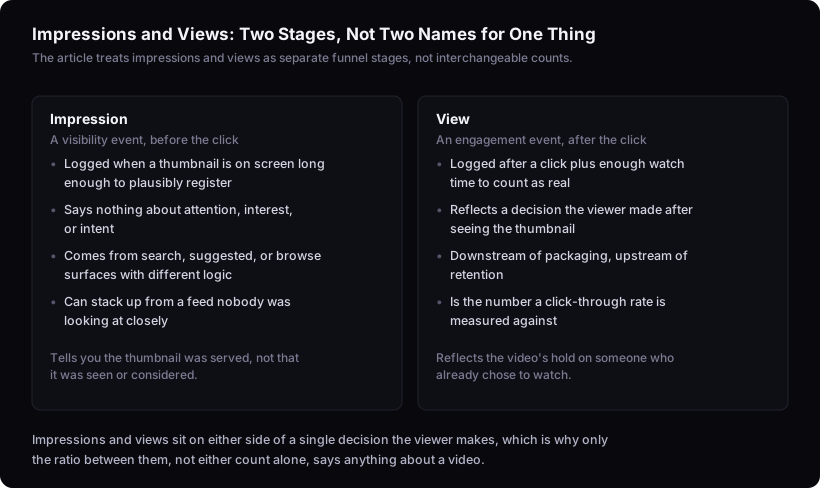
That decision is where the interesting information lives. Everything upstream of the click is about visibility. Everything downstream of it is about the video's own hold on someone who already chose to watch, which is a separate question covered in how to read your YouTube retention graph.
Why the same view count can sit under very different impression counts
Two videos with an identical view total can have wildly different impression totals, because impressions come from different surfaces that operate on different logic. Search impressions are driven by query matching and metadata. Suggested impressions come from a recommendation system comparing your video to what someone is currently watching. Browse impressions come from home-feed ranking based on a viewer's broader history.
A video ranked heavily in search might get relatively few impressions but convert a large share of them, because search traffic already knows what it wants. A video pushed hard into suggested or browse might rack up a large impression count from viewers who were never specifically looking for it, and convert a much smaller share. Comparing raw impression counts across two videos without knowing the surface mix behind each number is comparing two different kinds of traffic as if they were one.
Why more impressions isn't the win it looks like
A high impression count with a low click-through rate is usually a packaging problem, not proof of poor reach. The video is being shown; the audience seeing it is choosing not to click. That is a different failure than a video nobody sees at all, and it needs a different fix — the thumbnail and title, not the distribution.
This is the instinct worth correcting: impressions feel like the input and views feel like the output, so it's natural to assume more of the input should produce more of the output. It doesn't work that way, because impressions carry no information about whether the audience receiving them wanted the video. A smaller number of well-targeted impressions that convert at a strong rate is doing more for the video than a large number that mostly get scrolled past. The number worth watching is the ratio, not either side of it alone — which is exactly why titles need to hold a promise a viewer can act on in under a second, a discipline covered in how to title a YouTube video.
Turning the pair into a diagnostic: reading impressions and CTR together
Impressions and views combine into click-through rate, and CTR is the number that actually says something about packaging — but YouTube does not publish a benchmark for what a good CTR looks like, because it depends on niche, video length, thumbnail style, and where the impressions came from. Treating any single CTR figure as universally "good" or "bad" is exactly the mistake explained in what is a good click-through rate on YouTube?
What you can do without a benchmark is read the combinations against each other:
| Impressions | CTR | Likely read |
|---|---|---|
| High | Low | Packaging problem — the video is reaching people who don't click |
| Low | High | Strong packaging, weak distribution — worth investigating why it isn't being surfaced more |
| High | High | Working as intended |
| Low | Low | Neither distribution nor packaging is helping this one |
A low-impression, high-CTR video is often the one worth studying, not the high-impression, low-CTR one, because it shows a title and thumbnail earning attention from everyone who did see them. That's a signal about the packaging itself, separate from how far it traveled — the same signal a well-made thumbnail is designed to produce, covered in how to make a YouTube thumbnail that gets clicks. None of this replaces checking the basics first — what to check before publishing a YouTube video covers the metadata and setup issues that can distort both numbers before packaging is even the question.
What this can't tell you
Impressions and CTR come from YouTube's own definitions of what counts as shown and what counts as watched, not from testing across channels. This article can explain what the numbers mean and how to read them against each other. It cannot tell you what CTR or impression count is normal for your niche, your video length, or your channel size, because YouTube does not publish that benchmark and nobody outside YouTube has access to the full picture behind it. Any number offered as a universal target for your channel is a guess dressed up as a fact.
If you want the underlying vocabulary defined in one place, including how CTR and impressions sit alongside retention and other metrics, the metric glossary has the full set.