A format is worth copying only if it passes three checks: it repeats across independent videos, it holds up against similar videos that flopped, and its win comes from structure rather than surface style. Fail any one of the three and you are copying an anecdote, not a format. This article walks the three checks in order and ends with a go/no-go call, not a definition of what an outlier is.
Check one: has it actually repeated?
One great video tells you almost nothing. A format only becomes a candidate for copying once you've seen it work more than once, on more than one channel.
We treat three independent outliers as enough to get our attention, and five or more, preferably spread across different channels, as the point where we start trusting the pattern is repeatable rather than a coincidence. Below three, you don't have a format yet — you have a video that did well, which is a different and much weaker claim. If you're still hunting for the outliers themselves, how to find outlier videos in your niche covers the search step this check assumes you've already done.
Check two: does the graveyard agree?
The same working rule that sets the repetition bar also names this step directly: alongside counting independent outliers, we look at similar videos that failed, specifically so a lucky hit doesn't get mistaken for a repeatable pattern. This is not optional diligence. Survivorship bias is exactly the failure mode that makes a single hit look like a system: you see the video that worked and never see the ten attempts at the same idea that didn't, because nobody posts those in a "videos that flopped" compilation.
Pull up the channel or channels behind your candidate outliers and look for their near-misses — same topic, same rough setup, unremarkable result. If you can't find any, that's mildly reassuring but not proof; it may just mean nobody else tried the format yet. If you find several and the winner still stands out clearly against them, the format survives this check.
Check three: structure or skin?
A format's premise, title logic and thumbnail clarity can transfer to another channel. Its color grade, music choice and editing tics almost never do, because those are decoration on top of the mechanism, not the mechanism itself.
Before you copy anything, separate what actually did the work from what just happened to be present. A useful test: describe the format in one sentence without naming a single visual detail. If the sentence still explains why someone would click and keep watching, you've found the structural part. If the sentence collapses without mentioning a color palette or a specific creator's on-screen energy, you were about to copy skin. How to analyse a competitor's YouTube channel walks through pulling apart a channel's format this way in more depth.
Does channel size or niche change the answer?
An outlier proven on a much bigger or differently niched channel still needs re-testing against your own numbers before it counts as validated for you. Raw view count tells you almost nothing about whether a video is a real outlier for the channel that posted it — what matters is the multiple against that channel's own baseline.
We treat about 3x a channel's recent normal as the point where a video counts as a real outlier for that channel, with 2x worth noting, 5x strong, and 10x or more exceptional, and what matters throughout is the multiple against that channel's own recent baseline, not the video's raw view count. A video that hit 3x on a channel ten times your size is a real pattern signal. It is not evidence that the same structure will hit 3x on yours — different audience, different suggested-feed behavior, different starting point. The format passing checks one and two earns your attention. It still has to be tested on your own channel before you know it works there.
Pressure-test the title and thumbnail in seconds
You don't need to overthink the packaging check — it's meant to be fast. We check a thumbnail at actual feed size on a phone and give it under a second: in that time we should know where the eye is meant to go, understand the visual premise, and feel some curiosity, and if we have to study it, it's too complicated.
For the title, we trust clarity plus curiosity most: the premise should be immediately clear while leaving one question unanswered, and comparisons, extremes, consequences, contradictions and transformations tend to work as repeatable shapes, while vague, clever or overstuffed titles tend to repeatedly fail. Run your candidate format's title and thumbnail through both checks in under a minute. If either fails, the format's packaging logic isn't what you thought it was, and copying it will copy the wrong part. For a deeper pass on title mechanics specifically, see how to write YouTube titles that get clicks.
Decide, don't just admire
Three checks, one decision. If a format clears repeatability, survives the graveyard comparison, and its win traces to structure rather than style, it's worth copying. If it stalls on any one of the three, it isn't — not yet, and maybe not ever.
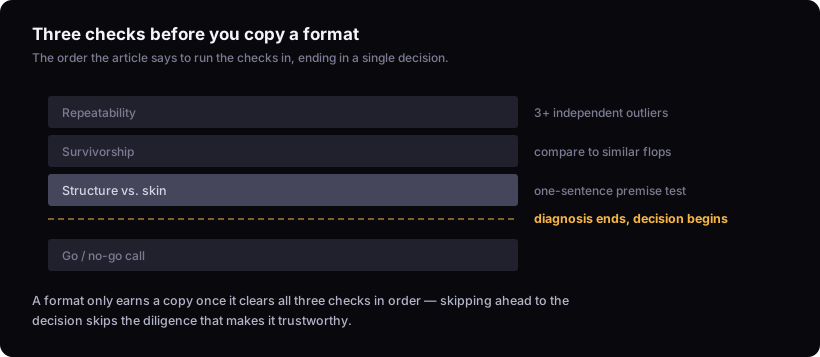
- Repeatability: three or more independent outliers, five or more across different channels for real confidence
- Survivorship: similar failed videos exist and the winner still clearly outperforms them
- Structure: the one-sentence premise test survives without naming a visual detail
Running this by hand across several candidate channels is slow. The video teardown and the channel watchlist exist to speed up the repeatability and graveyard checks specifically, by surfacing outliers and near-misses against a channel's own baseline rather than raw view counts.
What this filter can't tell you
This method tells you whether a format has repeatedly worked elsewhere and whether its structure is sound. It cannot tell you whether it will work for your specific audience — that only shows up after you publish. YouTube gives no benchmark for comparing CTR or performance across channels, and suggested and search placement depend on personalization and per-search engagement patterns nobody outside YouTube has visibility into. Passing all three checks earns a format the right to be tried. It does not guarantee the result, and nothing published anywhere can.