Competitor analysis on YouTube is not watching one rival's top videos and copying what they did. It is tracking a set of channels at once, over time, and testing whether something works before you build a video around it. A single channel's biggest hit tells you what worked for that channel once. It does not tell you whether the format works, or whether that channel just got lucky.
Why single-channel teardowns miss the real signal
A teardown of one channel answers "what did this channel do." It cannot answer the question that actually matters: would this work for anyone, or did it work because of who that channel's audience already is. Any channel's top ten videos will show a pattern eventually, because ten videos from one source share one audience, one upload history, and one set of prior recommendations feeding the algorithm. That is not evidence of a transferable format. It is evidence that one channel had a good few weeks.
This is the reason how to analyse a competitor's YouTube channel works best as one input into a wider system rather than the whole exercise. The wider system is what the rest of this article covers: build a set of channels, define what counts as a real signal on each, and only trust a pattern once it shows up independently more than once.
Building the competitor set worth watching
A competitor set is the group of channels you track together, chosen because they compete for the same audience attention, not because they are the biggest names in the niche. Size the set by relevance, not fame: a smaller channel publishing into your exact sub-topic is more useful to watch than a much bigger channel that only occasionally touches it.
Aim for enough channels that a pattern can show up more than once without it being the same channel repeating itself. A set of two or three tells you almost nothing, because you cannot separate "this channel's audience" from "this format." A watchlist of six to ten gives you room to see the same shape appear across different audiences, which is the actual test. The channel watchlist is built for holding a set like this and tracking it over time rather than re-searching it every time you want to check.
Telling a pattern from a lucky outlier
The first filter is whether a video is even worth paying attention to on its own channel. We treat about 3x a channel's recent normal as the point a video starts to look like a real outlier, with 2x worth a second look, 5x a stronger signal, and 10x or more exceptional — and we judge it against that channel's own baseline, not against raw view counts, because a video that would be nothing on one channel is a breakout on another. Those bands are a working judgement to calibrate to your own niche, not a fixed rule.
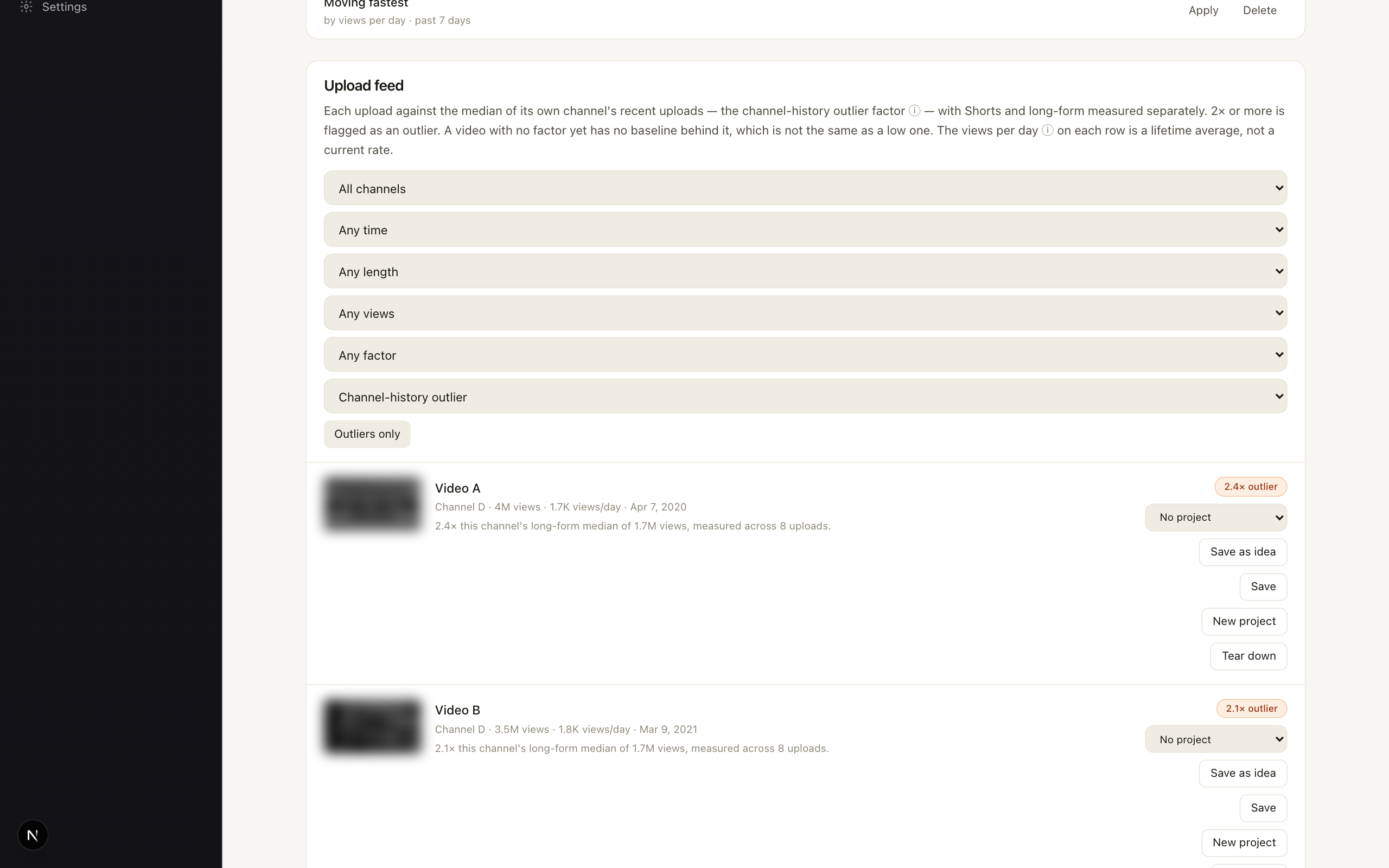
One outlier on one channel is a data point, not a pattern. We treat three independent outliers as enough to get our attention, and we start trusting a pattern as repeatable once we see five or more, spread across several channels rather than piling up on one. The word independent is doing the work there: a channel that returns to the same format five times only proves that channel's audience likes it, and the format is the thing you are actually testing.
The other half of that check is the failures. We look at similar videos that did not use the pattern and see how they performed, so we are not mistaking survivorship for a real effect. If nobody checks the attempts that flopped, a "pattern" can just be the videos that happened to work, retold as a strategy. How to find outlier videos in your niche covers the mechanics of finding the outliers in the first place; the multi-channel, multi-outlier check above is what turns a list of outliers into something trustworthy enough to act on. For background on what counts as an outlier at all, see what is an outlier video on YouTube?
What to actually compare: title, thumbnail and packaging
Compare the elements a viewer actually sees before they click: title, thumbnail, and the surrounding packaging on the watch page. These are the pieces YouTube's own upload flow treats as the viewer-facing description of the video, and they are the only parts a competitor controls that map directly to a click decision.
For thumbnails, judge them the way a viewer actually encounters them. The check we use: view the thumbnail at actual feed size on a phone and give it under a second — in that time you should know where the eye is meant to go, understand the visual premise, and feel some curiosity; if it takes longer to parse, the thumbnail is too complicated regardless of how good it looks zoomed in. Do this across the whole competitor set, not just the one video that grabbed your attention, so you're comparing packaging choices rather than one lucky frame.
For titles, look for structure rather than phrasing. The pattern worth trusting is clarity paired with curiosity: the premise is immediately clear, but one question is deliberately left open. In our experience, comparisons, extremes, consequences, contradictions and transformations are the shapes that keep reappearing across genuinely different channels, while titles that are vague, overly clever, or crammed with keywords keep failing regardless of the niche. How to write YouTube titles that get clicks breaks that structure down further.
Tags are not worth this attention. YouTube uses title, thumbnail, and description as the signals that inform discovery and viewer decisions; tags play a much smaller, largely disambiguating role and tell you nothing reliable about why a competitor's video performed. Spend your comparison time on the rest of the upload page — description, chapters, end screens — before spending any of it on a competitor's tag list.
From one-time audit to ongoing monitoring
A competitor analysis done once goes stale the week after you finish it. Treat the watchlist as a running habit: check it on the same cadence you publish, so new outliers get caught while they are still recent enough to matter.
That cadence should match what you can actually sustain elsewhere. The rule we work by: consistency beats an arbitrary upload frequency, and quality beats consistency — the right cadence is the fastest one you can sustain without weakening the idea, the title, the thumbnail, or the video itself. A newer channel benefits from more reps, because reps are where the judgement in this article gets built; a channel that already has that judgement should protect it rather than trade it for a tighter schedule. Fold competitor monitoring into whatever review you already do before planning the next video, rather than treating it as a separate research project.
What competitor analysis cannot tell you
This method only sees what YouTube exposes publicly: titles, thumbnails, publish timing, and view counts. It cannot see a competitor's click-through rate, audience retention, or where their traffic actually comes from — those numbers live in an analytics dashboard nobody outside the channel can access.
That means any comparison of "good" or "bad" performance between channels stays inferential. YouTube itself publishes no benchmark for what counts as good click-through rate or good retention, so there is no external number to check a competitor's public view count against. You can spot that a video did unusually well for that channel. You cannot know whether it did well because of the title, the topic, an algorithm push, or something in the first ten seconds you'll never see the graph for. Treat every pattern from this method as a hypothesis worth testing on your own channel, not a confirmed strategy borrowed from someone else's.