Not as a documented lever. YouTube's published documentation names broad categories — relevance, engagement, viewer satisfaction — and never singles out like or comment counts within them; whether those counts sit somewhere inside the engagement modelling is not knowable from outside. So the honest answer has two halves: nothing you can verify says they matter, and nothing you can verify says they don't. This article stays on that line throughout. What it does name is search relevance and engagement tied to the search query for search results, and predicted watch likelihood — shaped heavily by click-through rate and retention — for suggested videos. Likes and comments can travel alongside a video that's already winning on those fronts, which is exactly why they look causal when they aren't.
This rhymes with the trap tags fell into: a signal creators could see and touch, so creators assumed it must be doing more than the documentation supports. The rest of this piece separates the two.
What YouTube's own documentation credits for discovery
YouTube's creator-facing documentation describes two distinct systems, and neither singles out like or comment counts by name. Search ranking depends on how well a video's title, description and content match a viewer's query, combined with how well the video satisfies viewers who searched that term — measured through things like watch time on that result. Suggested videos work differently: the system predicts which video a viewer is most likely to watch and enjoy next, drawing on a viewer's history and on signals like click-through rate and retention for the video itself.
Neither mechanism, as YouTube describes it, offers a like count or a comment count as a lever you pull — the same disclosure-only claim as above, and the strongest version of it anyone outside YouTube can make. That doesn't mean YouTube's internal models never touch that data anywhere — nobody outside YouTube can say that with certainty — but it does mean there is no documented path from "get more likes" to "rank higher."
Where comments and likes fit, if anywhere
Likes and comments are visible social proof for viewers, and they may be folded somewhere into the same broad engagement modelling that also includes watch time, shares and other signals — but YouTube has never documented them as standalone ranking inputs. Treating them as a lever to pull is different from acknowledging they might exist somewhere inside a system nobody outside YouTube can see. The honest position is narrower than either extreme: not "likes do nothing at all," and not "likes are a ranking factor," but "YouTube has not told us they're a factor, and there's no published mechanism by which they would be."
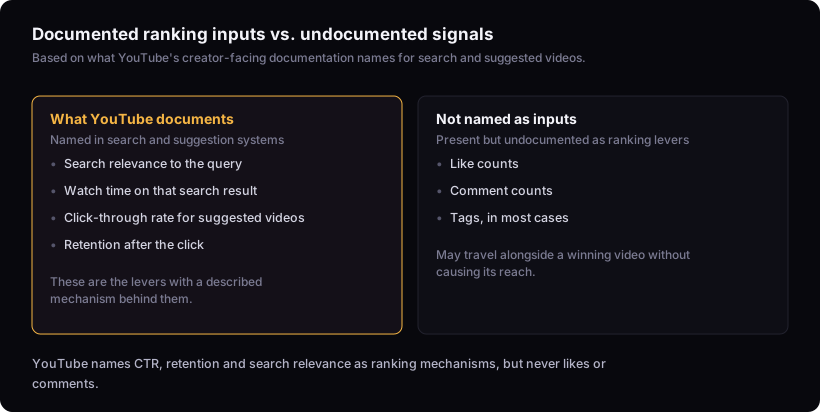
That gap matters for where you spend effort. A signal you can't verify and can't document is not one to optimize toward for the algorithm's sake — asking for comments that genuinely serve viewers is a different act, and fine.
Correlation without causation: why hits attract more comments
A video that already wins on title, thumbnail and retention reaches more people, and more people naturally means more likes and more comments as a byproduct of that reach, not as its cause. If a video's audience is ten times bigger than another video's audience, its raw comment count will usually be bigger too, purely from volume. Creators watching their own analytics see the correlation — big videos have lots of comments — and quietly reverse the causal arrow: comments made the video big. But the ordering runs the other way. The click-through rate and the retention curve got the video in front of people first; the comments arrived after.
This is worth checking against your own numbers rather than taking on faith. Pull up a video that did unusually well against your channel's normal range and look at when the comments landed relative to when the views started climbing. If the pattern holds, the comments followed the reach rather than preceding it.
The parallel to tags: another metadata myth
Tags are the closest precedent for this exact confusion, and YouTube's own guidance on tags plays out the same way likes and comments do: a field creators can fill in, widely believed to carry weight, that YouTube itself downgrades in importance relative to title, thumbnail and description match. The shared shape: a control the creator has direct access to gets treated as more powerful than the documentation supports, because it's the one thing that feels actionable. If you want the fuller argument on tags specifically, do YouTube tags still matter? covers what they actually do now.
The lesson generalizes: the presence of a field in YouTube Studio is not evidence that the field ranks you. Some fields are there for viewers, or for accessibility, or for search-engine indexing outside YouTube, and never touch the ranking system at all.
Should you still ask viewers to like, comment and subscribe?
Asking isn't harmful, but it shouldn't replace the work that's actually documented to matter. There's no evidence that an ask-for-engagement line hurts a video, and comments genuinely useful for other reasons — audience feedback, community building, a sense of whether the video landed — are worth having regardless of any ranking effect. The mistake is substitution: spending script time on a polished engagement pitch instead of on the title or the hook, on the theory that the pitch will move the algorithm. There's no documented mechanism for it to move the algorithm, and no way to verify an undocumented one.
If you're going to ask, keep it short and keep it honest about what it's for — audience connection, not a ranking hack — and put the rest of the effort where the documentation says it counts.
What actually moves the needle instead
The two levers YouTube both documents and hands you numbers for are click-through rate and retention — you can check and work on them directly rather than guess. CTR tells you whether your title and thumbnail are earning the click once a video is shown; retention tells you whether the video delivers on what the title and thumbnail promised once someone clicks. Both feed suggested placement and search performance in ways YouTube has actually described, unlike likes and comments.
Start with impressions vs views if you're not sure whether your problem is getting shown or getting clicked, then check average view duration to see whether the people who do click are staying. If a video underperformed and you're trying to work out why, a diagnostic on views walks through the checks in order rather than guessing at engagement.
The limit here
This article reasons from YouTube's published documentation and general method, not from a first-party test that isolates likes and comments as a variable. It can show that YouTube does not document a direct effect; it cannot prove the effect is zero. Comments and likes may play some minor, undisclosed role inside broader engagement signals YouTube has never fully described. Nobody outside YouTube can rule that out completely, including us. What can be said with confidence is narrower and still useful: there is no documented mechanism by which liking or commenting on a video moves it up a ranking, and the two mechanisms YouTube does document — search relevance and predicted watch likelihood — are where checking your own analytics will tell you something real.