The honest answer: stop treating comments as a chore you clear out, and start reading them as a feed of research on the video you just published. Replying, pinning and hearting are community habits that make a channel feel alive, but they are not where the value is. The value is in what commenters tell you, often by accident, about whether your title's promise landed, whether your thumbnail needed a caption to make sense, and what they wanted to see that you didn't make.
What YouTube actually rewards from comments (and what it doesn't)
Reply speed and comment count are not documented ranking inputs, and treating them as one means optimising for a number that may not move anything. YouTube's own guidance on how search and discovery work points to viewer satisfaction signals and how well a video matches what people are searching for or likely to watch next — not to how quickly a creator answers, how many replies a video accumulates, or whether comments are pinned. A comment section that is busy can be a symptom of a video people wanted to talk about, but the busyness itself isn't the mechanism.
This matters for where you spend time. If the goal is more views, hearting every comment within the hour is not the lever. Reading what those comments say about the video's packaging and content is closer to one, because it feeds decisions — the next title, the next thumbnail, the next topic — that do sit upstream of whether people click and watch.
Reading comments for packaging failures
A comment that says "I thought this was going to be about X" is a direct report on a mismatch between what your title or thumbnail promised and what the video delivered. That's not a complaint to smooth over — it's a diagnostic for the exact place your packaging misfired.
Look for three specific patterns. First, comments that restate the title back to you incorrectly — if several people describe the video's premise differently from what you intended, the title wasn't as clear as it read to you. Second, comments asking a question the video answers in the first thirty seconds — that's a sign the thumbnail or title buried the actual hook. Third, comments that only make sense if the commenter misread the thumbnail at a glance rather than studied it — since a feed gives a thumbnail well under a second before someone scrolls past or clicks, that misread is realistic, not careless viewing.
Feed what you find back into the next title and thumbnail rather than filing it away as generic feedback. If you're re-checking how to write youtube titles that get clicks, a comment thread full of "wait, so is this about A or B?" is telling you the premise wasn't obvious enough, even if the outcome was appropriately withheld. The same logic applies to thumbnails: if the pattern in comments suggests people needed the caption or the video itself to understand what they were looking at, that's the same failure a one-second phone-feed check is meant to catch before publishing, and comments are simply reporting it after the fact instead of before.
Mining comments for the next video idea
Comments are one of the cheapest sources of video ideas you have, because viewers are telling you directly what they want, in their own words, for free. The skill isn't finding a request — it's telling a real pattern from a handful of loud outliers.
A single comment asking for a follow-up is a data point, not a plan. A commenter's tangent, a recurring "can you do a video on—" across several videos, or the same complaint showing up from different people on different uploads is a different thing entirely — it's a candidate for the next thing you make, and it's worth ranking against everything else on your list rather than acting on the first one you see. If you're already maintaining the ideas or working through finding an angle, comment-sourced requests slot in as one more input to weigh against the rest, not a shortcut around the process.
The check that keeps this honest: does the request show up across more than one video, ideally from people who don't appear to be replying to each other? A thread where five people are quoting and agreeing with the first commenter is one opinion, not five. Independent repetition across separate uploads or separate viewers is what turns a comment into a real signal rather than a coincidence.
Handling criticism and negative comments without wasting time
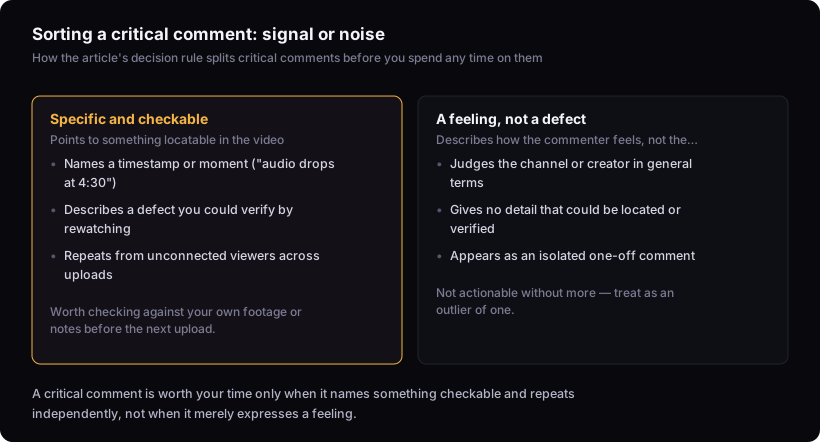
Most critical comments are noise, and the fastest way to waste an afternoon is treating every one of them as signal. The decision rule that scales: does the comment describe something specific and checkable about the video, or does it describe how the commenter feels about you, the topic, or the channel in general? "The audio drops out at 4:30" is checkable. "This channel has gone downhill" is not actionable without more — it's a feeling, not a defect you can locate and fix.
Deleting a critical comment doesn't change how many people see the video next, and neither does leaving it up. Moderation is about the experience of people reading your comment section, not a lever on reach. So the question to ask about a hostile comment isn't "should I delete this" — it's "does this repeat something else in the comments," because a single hostile comment is an outlier of one, while the same specific criticism from several unconnected people is the kind of pattern worth checking against your own footage or notes before your next upload.
A lightweight weekly comment-review routine
Set aside one short block a week, after your regular upload, rather than checking comments daily as they come in. Daily checking turns comments into a distraction from the next video; a weekly pass turns them into a research session with a fixed budget.
In that block, scan for three things across the videos published that week: any recurring misunderstanding of the premise, any repeated request for a follow-up, and any specific, checkable criticism showing up more than once. Note anything that clears that bar in whatever system you use to track ideas or packaging notes, and leave everything else. Reply to what genuinely needs a reply — a question worth answering publicly, a correction worth making — but don't treat the reply itself as the job. The job is the read.
This routine works at almost any publishing pace, because it scales with the videos you actually put out rather than with comment volume. Whether you're publishing weekly or trying to raise cadence, the review stays the same fixed block — the discipline that keeps a faster schedule from degrading the work is the same one that stops comment review from expanding to fill whatever time you give it.
The limit: comments are a hypothesis, not proof
Comment sections are self-selected. Most people who watch a video never comment on it, so whatever pattern shows up in the comments is coming from a small, vocal, unrepresentative slice of the audience — not from everyone who clicked. That's true even when the pattern is real and repeated.
Treat a comment-based pattern as a hypothesis worth checking, not a conclusion worth acting on directly. Before you change a title format, chase a video idea, or rework how you package a topic based on what commenters said, check it against retention and click-through data for the videos in question — see youtube impressions vs views: what the pair actually tells you and what is a good click-through rate on youtube? for what those numbers can and can't tell you. If the retention graph or CTR backs up what comments suggested, you've got something. If it doesn't, the comments were a loud minority, and the wider audience is telling you something different by watching in silence.
Comments also can't tell you about the video that never got clicked at all — the audience that saw your thumbnail and scrolled past leaves no comment, no trace, nothing to read. That's a blind spot no amount of comment analysis fixes, and it's a separate check from do youtube tags still matter? what they actually do now or anything else in your metadata. Comments tell you about people who stayed. They can't tell you about the ones who didn't.