No, not as a first move. Deleting a low-view video only changes anything if that video is actively damaging a discovery signal that affects the rest of your channel, and most of the time a quiet, low-view video is not doing that. It is just sitting there. The harder problem is that you usually can't tell the difference between "sitting quietly" and "actively hurting me" before you act, and deletion is permanent while the diagnosis is not. Do the diagnosis first.
What "underperforming" actually means
A video is underperforming relative to your own channel's normal range, not relative to some absolute view count. A video with a few thousand views can be a disappointment on one channel and a strong result on another, so the number by itself tells you nothing about whether to act.
This matters here because the decision to delete should depend on why a video underperformed, not on how far below average it sits. A packaging problem, a topic problem, and a distribution problem all produce a low view count, but only one of those is something deletion could plausibly touch, and it usually isn't the topic or the packaging.
What deletion actually changes on YouTube
Deletion removes the video and its metadata entirely; unlisting keeps the video live at its URL but pulls it from search, browse, and channel listings; leaving it public with low views changes nothing except that it stays visible and keeps accumulating whatever small trickle of traffic it gets. Only one of these three options is irreversible.
The open question is whether any of the three does something for your other videos. YouTube's own guidance on how videos get surfaced points to signals like watch time, click-through rate, and satisfaction feeding into search and suggested placement, and those signals are generally described per-video and per-channel-quality rather than as a shared pool that one bad video drains from the rest. That makes it hard to construct a mechanism where a single quiet, low-view video is actively suppressing a different video's reach. It's easier to construct a mechanism where a video with unusually poor retention or clickbait-adjacent packaging affects how the channel gets evaluated as a source, which is a distribution-quality question, not a "this number is too low" question.
None of this is something to trust as certain. Nobody outside YouTube can say exactly how one video's metrics interact with another's ranking, and this reasoning stops at what YouTube's documentation makes plausible, not at what it proves.
Diagnose before you delete: packaging, topic, or distribution failure
The fix depends entirely on which of three causes produced the low view count, and they leave different fingerprints in your analytics. Confusing them is the most common reason a repackage or a deletion doesn't help.
Packaging failure looks like reasonable or good retention once someone clicks, paired with a low click-through rate against your own other videos. The video is fine; almost nobody is choosing to watch it. Check your click-through rate the way what is a good click-through rate on youtube? lays out, comparing this video against your own history rather than an outside number, since a "good" CTR is channel-relative.
Topic failure looks like decent CTR — people are clicking — but retention falls off early and hard, meaning the premise sounded interesting but didn't deliver, or the audience for the title isn't actually the audience for the channel. how to read your youtube retention graph shows where in the graph that shows up and what a genuine content mismatch looks like versus a slow intro.
Distribution failure looks like low impressions from the start, regardless of what the CTR or retention numbers eventually say — the video barely got shown to anyone, so those numbers are built on too little data to read. youtube impressions vs views: what the pair actually tells you walks through how to tell whether you have a distribution problem before you draw any conclusion from CTR or retention at all.
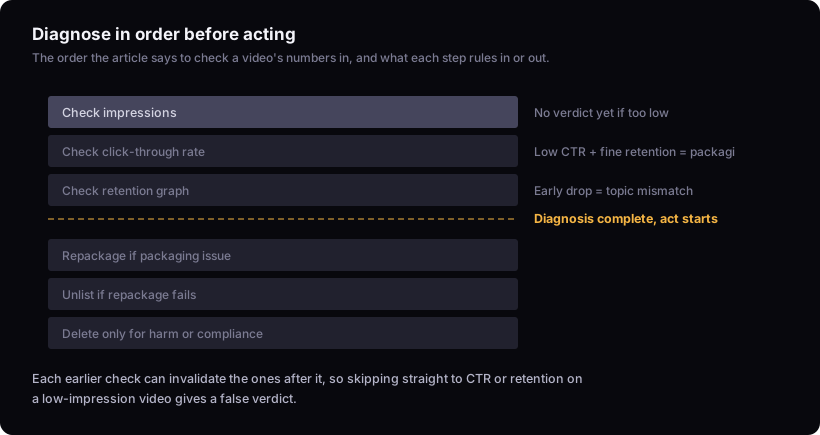
Run the check in that order: impressions first, then CTR, then retention. A video with almost no impressions doesn't have a packaging or topic verdict yet — it just hasn't been tested.
The case for repackaging instead of removing
Changing the title, thumbnail, or description keeps the video's accumulated watch history intact and lets you test a specific theory about what was wrong, which is the entire advantage repackaging has over deletion. If the diagnosis pointed at packaging — decent retention, weak CTR — that's a testable hypothesis: new title and thumbnail, same content, and you find out within a reasonable window whether the click problem was the click problem.
how to make a youtube thumbnail that gets clicks covers the mechanics of a rework, and how to title a youtube video (with working examples) does the same for the title half of the pair. Do both together if the diagnosis says packaging is the issue — changing only one makes it harder to know which change did anything.
Deletion forfeits this test permanently. Once the video is gone, you cannot go back and confirm whether the fix would have worked, and you've also erased whatever the retention and CTR numbers on that video were teaching you about your audience. A repackage that fails is still information. A deleted video that might have worked with a different thumbnail is just gone.
When unlisting or deleting is actually the right call
Low views alone are never a sufficient reason to delete or unlist. The legitimate cases are narrower and don't hinge on view count at all: the video contains information that's now outdated or incorrect in a way that could mislead someone watching it today, the content is far enough off-brand that it actively confuses a new visitor's impression of the channel when they land on it from an old link, or there's a legal, licensing, or compliance reason the video needs to come down.
In each of these, the problem isn't performance, it's harm or accuracy, and no amount of repackaging fixes it because the content itself is the issue. Unlisting is almost always the safer choice over outright deletion, since it removes the video from discovery while keeping it retrievable if you need to reference it, correct it, or reinstate it later.
A before-you-delete checklist
Work through this in order and stop as soon as one step gives you a clear answer:
- Check impressions. If the video barely got shown, you don't have a performance verdict yet — you have a distribution question, not a packaging or topic one.
- Check click-through rate against your own other videos. A low CTR with fine retention points at packaging, not content.
- Check the retention graph for where the drop happens. An early, steep drop after decent CTR points at topic or premise mismatch, not packaging.
- Try a repackage first if the diagnosis points at packaging. New title and thumbnail together, then give it time to be re-shown before judging it.
- Only after repackaging has been tried and failed, consider unlisting. Reserve outright deletion for the outdated-information, off-brand, or compliance cases above, not for view count.
If none of these steps clarify anything, why your youtube video isn't getting views: a diagnostic covers additional causes, including ones outside packaging, topic, and distribution entirely. For a structured pass through a specific video's numbers, the video teardown runs this kind of check against your own channel's history rather than an outside benchmark.
The limit on this reasoning
This argument is built from YouTube's public documentation on what drives search and suggested placement, not from tracking any channel's videos before and after a deletion. It can tell you what YouTube's stated mechanics make plausible or implausible — for instance, that a single quiet low-view video is unlikely to be suppressing a different video's reach — but it cannot tell you what will actually happen to your specific channel's numbers if you delete something. If you're weighing a deletion on a borderline case, that uncertainty is the reason to run the diagnostic checklist first: it's the only part of this you can actually verify against your own analytics.