Reviving a dead YouTube channel means treating it like a new upload with an inherited catalogue: your next video is judged mostly on its own packaging and performance, not on the channel's history. There is no confirmed mechanism that gets YouTube to recommend the old catalogue again the way it once did, and no confirmed mechanism that blocks it either — that's unresolved, which is itself useful to know before you decide whether to keep the channel, rename it, or start over. Start by checking whether the channel actually stopped getting distribution, or whether it simply stopped being updated: if you stopped uploading for reasons unrelated to performance — burnout, a life change, losing interest in the format — the fix is a working cadence and a packaging refresh, not a diagnosis of decline, since there was no decline to diagnose. If the channel kept uploading but views fell off, work out which of two different things did that, because the fix for one makes the other worse.
Why "dead" channels usually died of one of two causes
If the channel kept posting through the decline, it usually stalled for one of two structurally different reasons. The first is relevance decay: the channel drifted from the audience it once matched, or the niche itself moved on, so videos stopped showing up in search and suggested for the people who used to watch them. The second is packaging decay: the ideas and the audience are still fine, but the titles, thumbnails or opening seconds stopped earning clicks and watch time, so YouTube stopped testing the videos to new viewers.
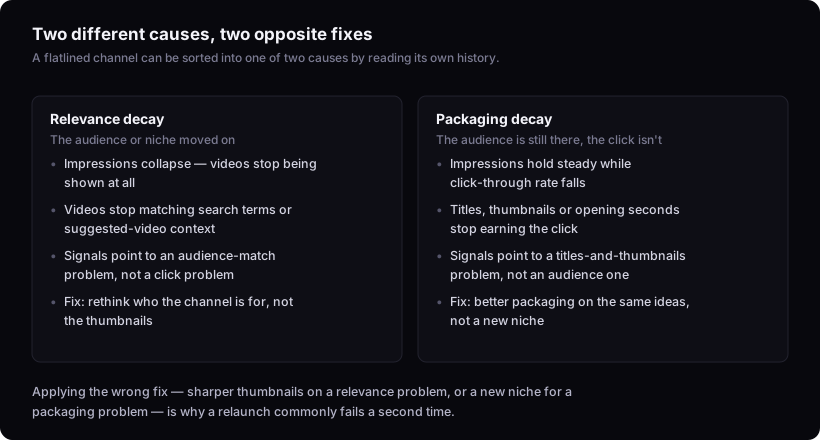
These look identical from the outside — a graph that flatlines — but they need opposite fixes. Relevance decay needs a rethink of who the channel is for. Packaging decay needs better packaging on the same ideas. Apply the packaging fix to a relevance problem and you get sharper thumbnails on videos nobody wants. Apply the relevance fix to a packaging problem and you abandon a niche that was never the issue. This is the most common reason a "relaunch" fails a second time: the diagnosis was skipped and the wrong lever got pulled.
Diagnose which one happened to you
You can sort your channel into one bucket or the other by reading its own upload history against its own metrics, not against any outside benchmark. In YouTube Studio, go to Analytics > Content, open the table view, and add impressions, click-through rate and average view duration as columns so the last twenty to thirty videos show all three at once, sorted by upload date. If your channel has fewer than that, use whatever videos you have — the shape of the trend across them matters more than the count.
To read the table without a benchmark, sort it by upload date and compare the median of your five most recent videos to the median of five videos from the last stretch that performed normally. If impressions are similar between those two groups but CTR is lower in the recent group, and the drop is roughly steady rather than a single sharp break, that leans packaging — YouTube kept surfacing the videos, but fewer people clicked. If impressions themselves are markedly lower in the recent group, that leans relevance — something about how the videos match search or suggested context changed. If both dropped together, treat it as relevance first, since a video that isn't being shown can't be judged on its click-through rate at all. [[e:youtube-impressions-vs-views]] and CTR are two different measurements answering two different questions, and neither one has a public benchmark you can compare across channels or time, so the only useful comparison is a video against your own channel's recent normal, not against "good."
Also check whether the decline was a gradual slope or a cliff. A slope across many videos usually means the niche or audience relevance eroded gradually. A cliff after one or two specific uploads usually means something about the packaging or topic choice broke sharply — worth checking against why your video isn't getting views for the fuller diagnostic. If you're unsure how to read the shape of the retention curve itself, how to read your retention graph walks through what a genuine hook problem looks like on the graph versus a genuine topic problem.
What actually resets with the algorithm, and what doesn't
Posting consistently again does not wake up or reset anything about how the channel as a whole is treated — there is no publicly confirmed mechanism where dormancy accrues a penalty that a return schedule clears. What a consistent schedule does instead is give you several independent attempts, each judged on its own packaging, rather than one — and a pattern across several of those attempts is the best available evidence of whether your new approach is working, even though no single video's outcome is proof. YouTube's own documentation on how search and discovery work describes each video being evaluated on signals like title and description match, and how well it performs with viewers who see it, not on the channel's recent upload gap. In practical terms, your comeback video is judged close to on its own merits: its title, thumbnail, and how it holds an audience once clicked.
What consistency actually buys you is more attempts, sooner, to find a version of the fix that works — a different claim from "resets the algorithm." Posting once and waiting to see what happens teaches you one data point; posting several videos gives you several. That said, cadence should never come at the cost of a weaker idea, title or thumbnail — a comeback video that goes out on schedule but represents the old packaging teaches you nothing about whether the new approach works. If you're unsure what cadence is sustainable versus arbitrary, how often should you upload covers the tradeoff in more depth.
Rebuilding the first videos back: packaging before volume
The first videos back need different titles, thumbnails and opening seconds than whatever was running when the channel went quiet — not just more of the same format at a faster pace. If the diagnosis above pointed to packaging decay, this is the entire fix, and it needs to be done properly on a small number of videos rather than loosely across many.
For titles, look for a version that states the premise clearly while leaving one specific thing unanswered — a comparison, an extreme, a consequence, or a stated before/after work repeatedly because each one commits to a premise and withholds only the outcome. A title that's vague or trying to be clever usually fails for the opposite reason: it doesn't commit to anything the viewer can react to. How to title a video has the fuller set of working patterns. For thumbnails, the fastest test available to you is to open the image at actual feed size on a phone and look at it for under a second — if you can't tell where your eye should go or feel some curiosity in that time, it's too busy for how it will actually be seen in a scrolling feed. How to make a thumbnail that gets clicks goes through the construction of that in detail.
If the diagnosis pointed to relevance decay instead, packaging alone won't fix it — the harder work is confirming the niche still has an audience: look at whether channels currently succeeding in adjacent topics are covering something different from what you were making, and whether the search terms and suggested contexts your old videos relied on still lead to your kind of content or have shifted to a different format or angle. That's a slower rebuild than a packaging fix, and how to find your niche covers it in full.
Deciding what to do with the old catalogue
Deleting old underperforming videos is not something to do by default, and there's no confirmed evidence that removing them improves how new videos get recommended. The reasoning that holds up: suggested and search placement are driven by signals tied to the individual video and to what performs well with the audience currently watching it, not by the total weight of a channel's back catalogue dragging newer uploads down. Old videos sitting with weak CTR do not appear to actively suppress new ones, based on how YouTube describes its own ranking signals — but this isn't something that's been tracked on an actual channel through a revival, so treat it as reasoning rather than a guarantee either way.
The stronger case for leaving old videos up is that some of them may still carry evergreen search value even if they no longer get suggested placement — deleting a video removes any of the search traffic it does have, permanently, in exchange for a channel-cleanup benefit that isn't confirmed. If a handful of videos are actively embarrassing or badly misrepresent what the channel does now, unlisting rather than deleting keeps the option reversible — with the tradeoff that an unlisted video stops appearing in search and suggested entirely, so it also stops the evergreen search traffic the case for keeping videos up depends on. It's a way to hide a specific video from new viewers while keeping the option to relist it later, not a way to keep its search value while hiding it.
How to tell if the revival is working
Judge the first few comeback videos against the channel's impressions right before it went quiet, since that's the most recent real baseline you have — not against an old high point from years earlier. Watch impressions first: are the new videos being shown to anyone at all, compared to that pre-dormancy level? Then watch CTR and retention on those impressions, since what counts as a good CTR depends entirely on your own recent numbers rather than any general figure.
One video crossing into outlier territory is worth noticing but isn't proof the fix worked — a single video landing around three times the channel's recent normal is a real signal, but one data point can be luck as easily as method — a pattern across several videos, with a couple of misses mixed in, is what tells you it's the packaging and not one topic that happened to work.
The limit here
This reasoning follows from YouTube's published documentation on ranking and metrics, not from tracking any actual channel through a revival, so treat it as the best available reasoning rather than a guarantee of a specific outcome.