Start here: pick five to ten channels loosely in your area, open each channel's uploads tab, and sort by date rather than by popular. Scroll the last few months and look for one video sitting well above the others around it in views — not the channel's biggest video ever, just a clear step up from what that same channel usually gets. Do that across several channels and you're looking for the same angle repeating as an overperformer on more than one of them. That repeat, not a topic word, is your niche.
Most niche advice instead tells you to list your interests, list your skills, cross-reference with an audience, and pick the overlap. That produces a label, not evidence. A niche found this way is a bet on your own taste, made before a single viewer has told you anything. The rest of this article works through how to run the scan above properly, how many outliers should convince you, and what to do with your own results once you have them.
Why picking a niche from your interests is backwards
The standard method asks you to introspect: what do you know, what do you love, who would want to watch that. None of those questions touch whether anyone is actually rewarded for making that content. You can be genuinely expert in something and still find that the format nobody clicks on. Interest tells you what you could sustain making. It tells you nothing about what an audience responds to, because you haven't looked at an audience yet — you've looked at yourself.
This isn't an argument against caring about your topic. It's an argument against using care as the selection filter. Selection should come from evidence you can point to; commitment can come from wherever it needs to.
What a niche actually is: a pattern, not a topic label
A niche is a repeatable pattern of demand, evidenced by videos that outperform their own channel's normal — not a category name like "productivity" or "van life." Two channels can share a topic label and have completely different niches, because the label describes the subject and the niche describes what specific angle on that subject keeps getting rewarded.
This is why "pick a niche" advice that stops at a topic word is incomplete. "Cooking" is not a niche. "Recreating restaurant dishes from a description with no recipe" is closer, and only counts as a niche once you can show it working more than once, on more than one channel.
Finding the evidence: where to look for repeatable outperformance
The evidence you're looking for is videos that clearly beat their own channel's baseline, not videos with a lot of raw views. A video with a modest view count can be a real outlier if it's far above what that channel normally gets, and a video with a huge view count can be an ordinary result for a channel that always does that number. Raw views compare channels to each other. What you need is each video compared to its own channel's history, because that's the only comparison that tells you demand exists independent of channel size.
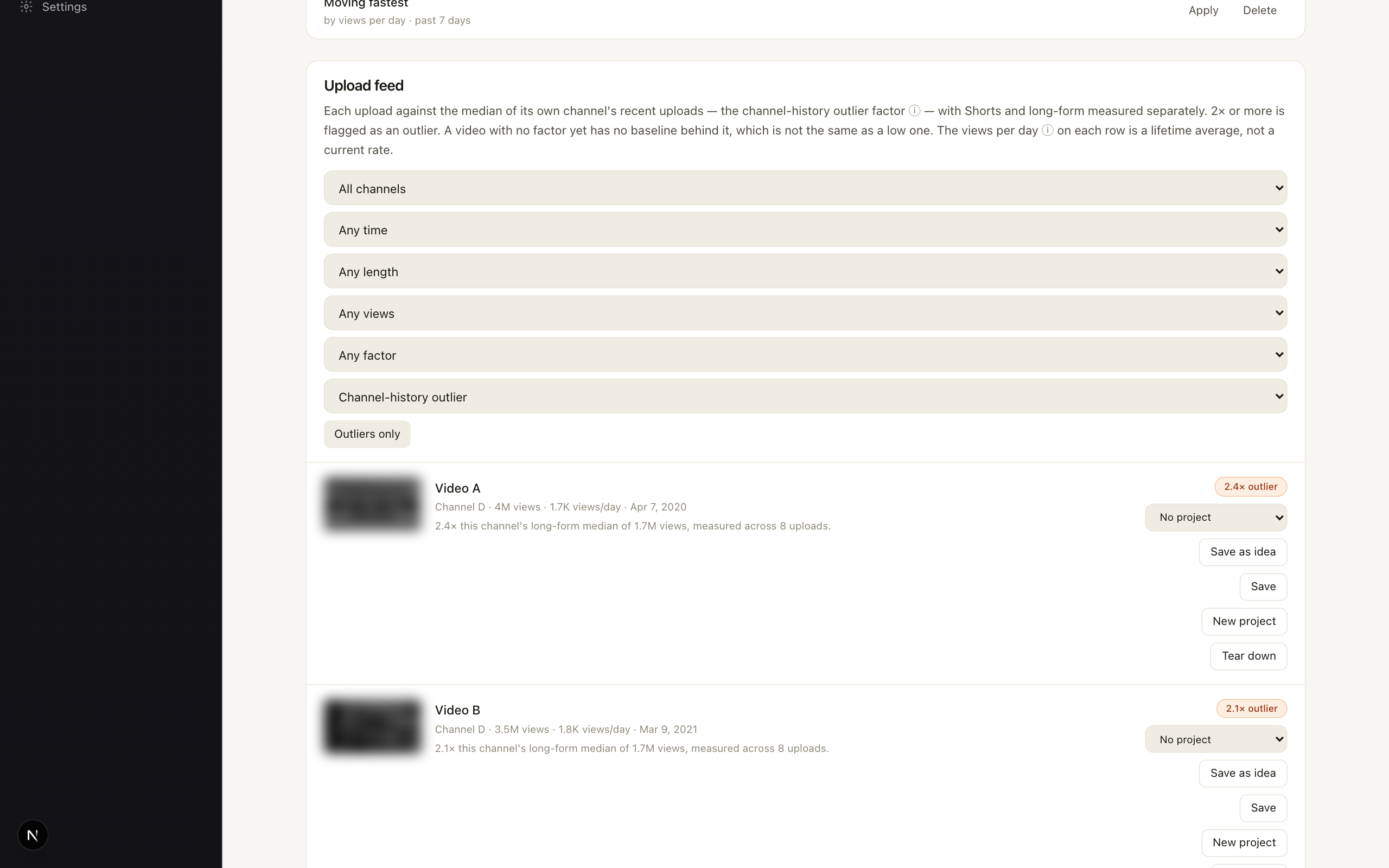
Scanning for this means going wide. Start from channels you already watch, then add the ones YouTube suggests alongside them and the ones that turn up if you search the broad subject directly — aim for somewhere around ten to twenty, more than the one or two you already watch out of habit. For each one, open the uploads tab, sort by date, and scroll back a few months so you're looking at the full run rather than just the popular tab. You're checking each video against the videos immediately around it on that same channel, not against other channels, and looking for the same angle repeating as a clear step up more than once. The channel watchlist automates this scan and flags the step-up for you, but the manual version above works without it — it's just slower to repeat.
How many outliers before you trust the pattern
One outlier is a curiosity. Three or more, spread across channels that don't share an audience, is a pattern worth taking seriously — and that spread matters more than the raw count. "Don't share an audience" has a rough check: look at subscriber counts (a similar-sized channel isn't just feeding off a bigger one's audience), skim the comments for repeat usernames, and note whether the channels are in the same language or region. If two channels overlap heavily on all three, treat an outlier repeating between them as one data point, not two.
A format repeating on a single channel only proves that channel's existing audience likes it — you haven't ruled out that the channel's own subscribers are the whole explanation. Seeing the same angle overperform on channels that pass the independence check above is what tells you the demand is coming from the angle itself.
It's also worth checking for similar videos that flopped, and this is the harder search: flops don't surface in a channel's popular tab or in recommendations, so you have to go looking. Open the uploads tab sorted by date rather than by views, and scan for videos with the same title shape or angle as your outliers but ordinary or low view counts sitting next to them. If every attempt at an adjacent angle succeeded, you might just be noticing the survivors and missing the failures sitting in that same list. A pattern only means something once you've checked that list and can say why the outliers were different from the flops next to them. As a working rule: line up a channel's last fifteen or so uploads by date, note the two or three that sit clearly above the rest, and check whether those are recent enough that view count differences aren't just about the video having had more time to accumulate views. That's enough to start spotting outliers by eye. How to find outlier videos in your niche and what is an outlier video on youtube? go further into edge cases like video age and format changes.
Watch for the single lucky hit, too. A video that spikes once, on one channel, with nothing else nearby resembling it, is a data point, not a pattern. It might be a trend that passed through, a title that overpromised, or genuine luck. Don't build a niche decision on it until something similar has worked somewhere else.
Turning the pattern into a niche you can commit to
Once you trust the pattern, describe it as the audience question the outliers keep answering, not as a subject. "True crime" is a subject. "What actually happened, told in the order the investigators learned it, with no dramatization" is the audience question a set of overperforming videos might be answering. That version is specific enough to test: you can make a video that answers the same question in your own way and see whether it outperforms the rest of your own output so far. If you have no upload history yet to compare against, the first real test is simpler: does it outperform your very next few videos on other topics, once you have some to compare it to. Either way, the comparison is always against your own prior results, never against someone else's channel.
A subject label can't be tested, because it doesn't commit you to anything specific enough to fail. A pattern stated as a question can. If your first video against the pattern flops, you've learned something real about whether the pattern applies to you; if you'd only committed to a subject, a flop tells you nothing you can act on. Finding an angle is the method for turning a pattern like this into a specific video idea rather than a vague direction, and how to find youtube video ideas covers generating those ideas once the niche is set.
Narrowing or widening once you have early data
Your own uploads are the next round of evidence, not a formality after the niche is chosen. If your videos against the pattern consistently outperform your other work, the niche is validated and narrowing further — sharpening the angle, dropping the parts of your channel that don't fit it — usually pays off. If two or three attempts land flat while the pattern still holds on other channels, the mismatch is worth investigating before you assume the niche is wrong. Start by comparing your video directly against one of the outliers it was modeled on: same question answered, but check the title's specificity, whether the thumbnail shows the outcome or the setup, and how far into the video the payoff arrives. If you genuinely can't find a difference after that comparison, treat it as a real signal against the niche rather than a search you gave up on. How to analyse a competitor's youtube channel covers this comparison in more depth.
How often you publish while testing this matters more than most niche advice admits. The rule we work by: consistency beats an arbitrary schedule, and quality beats consistency — the point is to publish at the fastest pace you can sustain without weakening the idea, the title, the thumbnail, or the video itself, since a rushed video against a real pattern will look like the pattern failed when it was actually the execution. In our experience a newer channel benefits from more attempts, because attempts are how the judgement about what fits gets built; a channel that already has that judgement should protect it rather than trade it for a heavier schedule. If you're unsure what pace is sustainable for where you are, how often should you upload to youtube? a diagnostic walks through that separately from the niche question.
What this method can't tell you
This method identifies niches by finding evidence of demand that has already shown up publicly as outperformance across channels. It cannot predict whether an untested niche will work for you specifically, and it cannot account for competition or saturation that develops after you commit — a pattern that was open six months ago may be crowded by the time you publish into it. It's also not a substitute for the feedback of actually publishing: the pattern tells you where to start testing, not what your outcome will be. The only reliable evidence about your channel is your channel's own results, compared against the pattern over time, not against the pattern alone.
Start there. Pick the pattern with the most independent evidence behind it, publish your first attempt against it, and let that result — not your interest in the topic — decide what happens next.