There is no correct number. Daily, weekly, twice a week — none of these is right or wrong on its own, because frequency is not the actual problem you're trying to solve. It's a proxy for a question you haven't answered yet: is your channel constrained by discovery, or by packaging and retention? Get that answer first, and the frequency question mostly answers itself.
Why "how often" is the wrong first question
Frequency is an output, not an input. It's the number you land on once you know what's actually holding your channel back, not a dial you turn hoping for improvement. Picking a number off a chart — "successful channels post three times a week" — skips the diagnosis entirely and treats every channel's problem as the same problem.
There's a version of this advice that says uploading more often makes the algorithm "favour" a channel — feed it more, get rewarded more. Nobody outside YouTube knows what its recommendation systems weigh, and no one who says otherwise has access you don't. What's more likely, mechanically: more uploads means more chances for a video to find its audience, and more data for the channel overall. That's a different claim from "more uploads gets special treatment," and it's the one you can actually reason about.
The two failure modes frequency gets blamed for
Almost everyone who asks about frequency actually has one of two separate problems, and they call for opposite responses.
Discovery problem: your videos aren't getting a fair shot to be seen at all. Impressions are low across the board, regardless of what's in them. In this case, more shots on goal can genuinely help, because the constraint is volume of attempts.
Packaging or retention problem: videos are being shown, but people aren't clicking, or they click and leave fast. Here, more uploads doesn't add more chances to succeed — it adds more chances to repeat the same miss. This is the far more common one, and it's the one frequency advice usually gets wrong, because it assumes the bottleneck is exposure when it's actually the video itself. If this sounds like your situation, why your YouTube videos aren't getting views goes into the mechanics of that gap.
A quick self-diagnostic before you change anything
Pull up your last eight to ten uploads and check three things against each other, not against a benchmark.
Are impressions roughly flat and low across most videos, regardless of topic or thumbnail? That points toward a discovery problem — the videos aren't reaching enough people to judge anything else.
Are impressions reasonable but click-through rate consistently weak? That's packaging. The videos are being offered and turned down.
Do people click but the average view duration falls off early and consistently? That's retention, which is a different fix from packaging but sits in the same category: the video isn't holding up its end once someone gives it a chance.
If you see the second or third pattern, uploading more often will not touch the actual problem. If you see the first, it's worth checking whether it's frequency itself or something else entirely — a look at how to analyse a competitor's YouTube channel in your niche can tell you whether channels similar in size are getting meaningfully more impressions per video, which narrows down whether the gap is really about how often you post.
What happens if you raise frequency without fixing the real constraint
The arithmetic is straightforward: if the click-through and retention problems that were capping your existing videos stay unfixed, adding more videos multiplies the same weak performance rather than replacing it. Total channel views can rise, because you've simply got more videos out there collecting views, but average views per video tends to fall, because each new upload is subject to the same packaging or retention ceiling as the last one.
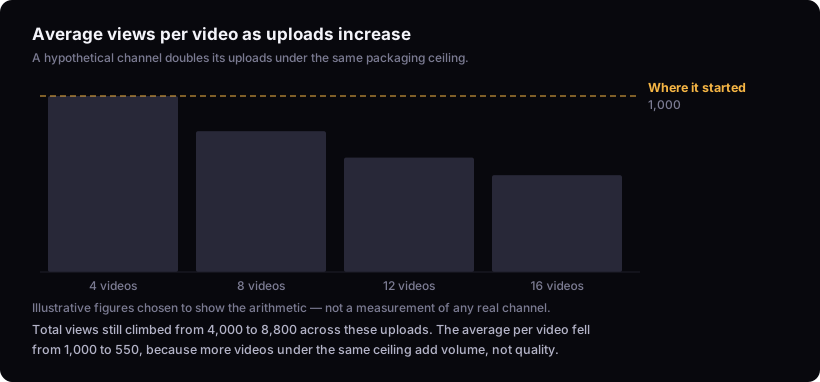
This is the trap in reading total watch time or total views as a health metric. A channel can look busier and even look bigger on a dashboard while every individual video is doing worse than the ones before the frequency increase. If you don't know whether your recent output includes anything that broke that ceiling, what is an outlier video on YouTube? explains what a genuine breakout looks like against a channel's own baseline, which is the more useful comparison than any external number.
Should a small or new channel upload more or less often than an established one?
Neither answer is automatic — it still depends on which constraint is active, not on channel age alone. A newer channel with almost no impression history sometimes benefits from more volume, simply because there isn't yet enough data or enough attempts to know what works. But that only holds if each video is still being made with real care in the title, thumbnail and opening; volume without packaging just produces more evidence of the same problem, faster.
An established channel with a stable audience and steady baseline is usually better served by holding frequency constant and improving the packaging on what it already makes, since it already has enough data to know where the weak point is. If you're not sure whether your niche has channels doing something structurally different at a similar size, how to find outlier videos in your niche is the more direct way to check than guessing from general advice.
Setting a frequency you can actually sustain
Once you've addressed the actual constraint — or at least identified it — the frequency decision becomes practical rather than strategic. Three things matter more than any target number:
| Factor | What to check |
|---|---|
| Production capacity | Can you make this many videos to a consistent standard without cutting corners on the parts that drive clicks and retention |
| Batching | Can research, filming and editing be grouped so quality doesn't degrade as volume rises |
| Consistency over time | Can this cadence survive a bad week, a busy month, or burnout, without collapsing to zero |
A cadence that fails any of these three eventually reverts to something lower anyway, just later and after more strain. It's worth working through the rest of the upload page once frequency is settled, since packaging decisions made per-video are what determine whether more uploads help or hurt at whatever cadence you land on.
When to revisit the number
Frequency isn't a setting you choose once. As packaging and retention improve, the same cadence that used to dilute performance can start to genuinely add reach, because each new video is no longer capped by the same weakness. Revisit the question every time you make a meaningful change to titles, thumbnails, hooks or editing — not on a fixed schedule, but tied to whatever you've actually changed. Keeping an eye on similar channels over time with the channel watchlist can help you notice if the field around you is shifting cadence for reasons worth understanding, rather than reasons worth copying.
The limit here
This diagnostic can point to which constraint is likely limiting a channel, based on general patterns in how discovery and retention work. It cannot read your specific analytics, confirm that frequency caused any particular outcome on your channel, or account for niche-specific quirks and algorithm timing that aren't publicly documented. Treat it as a starting question, not a verdict — check your own numbers before you change your schedule.