Most of what decides whether a video gets watched is settled before upload, not by anything you do to promote it afterwards. Sharing a link on Reddit, Twitter or a Discord server can bring a handful of extra viewers, but it does very little to influence whether YouTube's search and suggested systems decide to circulate the video further. The fixable part of promotion mostly happened before you hit publish: whether the title and description match what someone is searching for, whether the thumbnail wins the first look, and whether the video is built to hold the audience YouTube already knows how to send it. External sharing is real but minor. This article treats it that way: the work that decides discovery happens before upload, and the external sharing most people call promotion comes last, as the smallest lever.
Why external sharing rarely moves the algorithm
A burst of clicks from outside YouTube adds views, but it doesn't compound the way a lot of advice implies. YouTube's suggested and search systems run on signals collected on the platform itself: what someone searched for, what they watched next, how long they stayed. Traffic arriving from a tweet or a forum post carries almost none of that context with it.
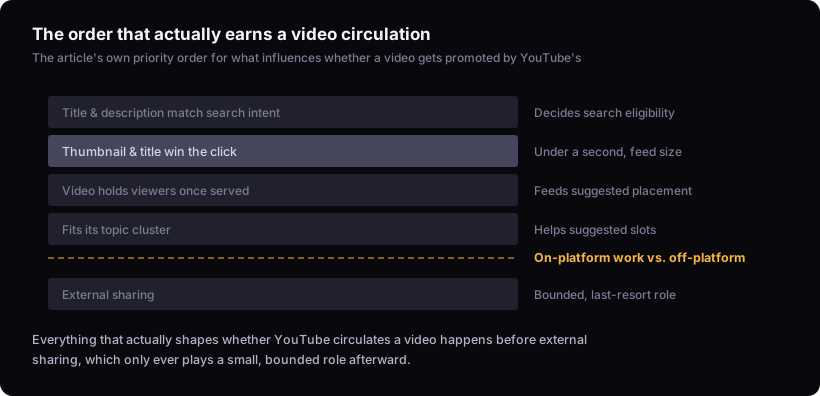
This matters because the instinct after a flop is to push harder externally: post it again, message it to a few group chats, hope the extra views convince the algorithm the video deserves a bigger audience. That instinct treats YouTube's systems as a scoreboard that responds to raw view count. They don't work that way. A short burst of outside traffic that doesn't stick around, click through to something else, or match what a search or suggested slot was trying to serve tells the system very little about whether to keep circulating the video.
What actually earns search placement
YouTube's own guidance on search points to two things: how closely a video's title, description and content match the words someone typed, and how well the video performs once it's served for that query. Neither of those is something a link shared off-platform can fix.
Matching is more literal than most creators assume. If someone searches "how to fix a bike chain" and the title, spoken content and description are all about "bike chain" the way that searcher means it, the video is eligible to rank for that query in the first place. If the phrasing is a metaphor, an in-joke, or aimed at a different intent, the title won't match what anyone actually types, however relevant the video itself is. Getting to eligible only opens the door; what happens after someone clicks from search results is what decides whether the video keeps that placement.
What actually earns suggested placement
Suggested videos are chosen around what a specific viewer is likely to watch next, based on that person's own history and the video's relationship to what they were already watching. This is why a single well-promoted video rarely moves the needle on suggested placement by itself. The system is trying to match a viewer's session, not reward an upload for effort spent outside it.
A video's fit inside its own topic cluster carries more weight here than any sharing campaign. If the video sits clearly next to other videos a given audience already watches on the platform, it has a natural path into suggested slots. If it's a one-off departure from what the channel or the niche usually covers, suggested placement has little to grab onto, no matter how many people click a shared link from outside.
The tags myth, retired
Outside of correcting a common misspelling, tags do not meaningfully help a video get discovered. YouTube's own help documentation describes tags as a minor aid, mainly useful for correcting common misspellings of a title or topic — not a discovery lever. Creators who spend time filling fifteen tag slots are spending effort on a task that YouTube itself frames as marginal.
The effort is better spent on the things that do carry discovery weight: the title and description that determine search match, and the description that gives the algorithm and the viewer the same clear statement of what the video actually is.
The click-through decision point: thumbnail and title
Once a video is served — in search, in suggested, or on a subscriber's home feed — whether it gets watched comes down to the click: the impression has already happened, and the thumbnail-and-title pair decides what fraction of those impressions turn into views. That fraction is what's usually meant by click-through rate, and there's no fixed number that counts as good, because it depends on where the impression happened, the size of the audience it was shown to, and what that channel's own typical numbers look like. Chasing a benchmark from someone else's channel is chasing the wrong thing; the only comparison worth making is against your own similar videos. For a longer treatment of what the click-through rate figure can and can't tell you — that article's answer is also that only your own baseline counts — and how impressions relate to views in the first place, those are separate questions worth answering on their own.
What you can control is the thing being judged in that fraction of a second. A useful check: look at the thumbnail at actual feed size on a phone, and give it under a second, because that is roughly what a real feed gives it. In that time the eye should know where to look, the visual premise should be obvious, and there should be a little curiosity left unanswered — if it takes study, it's too complicated, and that's a working rule rather than a measured cutoff. The title carries the same job from a different angle: the premise stated clearly, one question left open. This is a pattern worth trusting because it repeats — comparisons, extremes, stated consequences, contradictions and transformations all work by stating the premise and withholding the outcome, and it's a rule of thumb worth applying rather than a guaranteed formula. Vague or overstuffed titles tend to fail the same test from the other direction: nothing is withheld because nothing was clear to begin with. If you want worked examples of the shapes that hold up, how to title a video and how to build a thumbnail that gets clicks go through this in more depth than fits here.
Where external promotion still earns its place
External sharing has a real, bounded job: it can give a new channel its first handful of viewers before the platform has enough signal to act on its own, and it can add short-term momentum to a video that's tied to a specific date or event. Neither of those is the same as fixing a video the algorithm has already decided not to circulate.
If a video isn't getting picked up in search or suggested, more sharing is unlikely to change that outcome, because sharing doesn't touch the two things those systems actually run on: query match and on-platform engagement. Where a video's underlying problem is something else entirely, a diagnostic on why it isn't getting views is a better next step than another round of posting the link.
A pre-promotion checklist
Before spending time sharing a video externally, it's worth running through the on-platform checks first, since they're the ones that actually influence what YouTube does with the video:
| Check | What to look at |
|---|---|
| Title match | Does it state the premise clearly and match how someone would actually search or describe the topic? |
| Thumbnail | Does it read at feed size in under a second, with one clear point of focus? |
| Description | Does it plainly restate the topic in the same language a searcher would use? |
| Tags | Skip unless correcting a common misspelling — otherwise not worth the time |
| Early engagement | Is the video built to hold viewers through the first section it's judged on? |
Running through a full pre-publish pass, not just this list, is worth doing before a video goes live at all — see what to check before publishing a video for the complete sequence. External promotion is the last step, not the first.
What this can't tell you
This reasons from YouTube's published documentation on search ranking, suggested videos and impressions and CTR. It can't tell you what will happen to any specific video, because YouTube doesn't disclose the exact weighting of these signals or how personalisation shapes any individual viewer's suggestions. It also isn't based on first-hand testing or channel data — treat it as a way to prioritise effort, not a prediction of outcome.