A YouTube description is not one paragraph of SEO text. It does three separate jobs — helping discovery, converting an already-watching viewer into a click somewhere else, and giving you legal cover for sponsors, affiliates and music — and each job needs different content in a different position. Write it as one undifferentiated block and you'll optimize the wrong part for the wrong job, usually burying the thing that mattered under the thing that didn't.
This guide gives you the order to write in, not just the parts to include. It won't tell you how much any of this moves your placement in search or suggested, because nobody outside YouTube can quantify that, and it won't rescue a video that never earned the click in the first place.
The description box actually has three jobs, not one
Most advice treats the description as a single keyword field. It's actually three functions competing for the same space: feeding whatever YouTube's systems read to match your video to a query or a session, pushing an already-watching viewer toward another video, a link, or a subscribe action, and covering the legal and platform requirements around sponsorships, affiliate links and third-party music.
Each job wants different content. Discovery wants context about what the video actually is. Conversion wants a specific link and a reason to click it right now. Compliance wants boilerplate that's the same on every upload, placed somewhere it won't crowd out the first two. Treating all three as "the description" is why so many descriptions read like nothing — they're trying to do three jobs in one voice.
| The job | What it wants | Where it goes |
|---|---|---|
| Discovery | Context about what the video actually is, in the words a viewer would use | The first two lines |
| Conversion | One specific link and a reason to click it now | Just below the fold |
| Compliance | Boilerplate that is identical on every upload | Last |
What's visible before the fold, and why it outranks everything else you write
Only the first couple of lines show before a viewer has to tap "more." Everything after that is functionally invisible until someone actively clicks to expand it, which most viewers never do. That makes the first two lines the single highest-value piece of real estate in the entire box, worth more than anything below it combined.
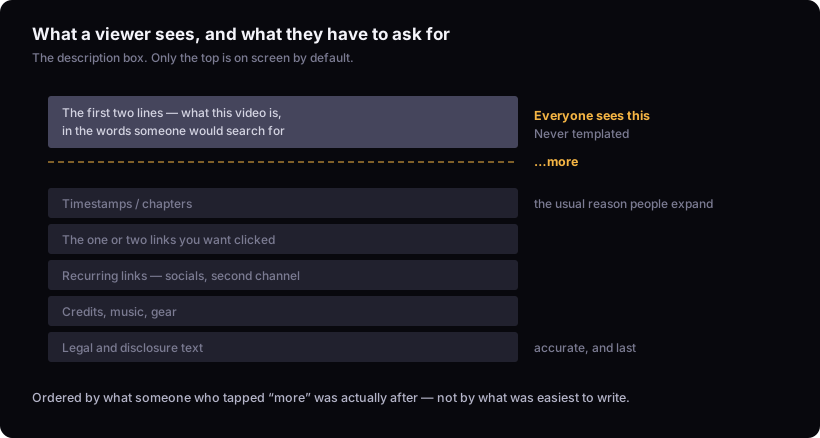
This is where a specific, accurate summary of the video belongs — not a slogan, not a hook copied from the title, but a plain sentence or two that tells someone (and whatever system is parsing the page) exactly what's in the video and why it matters. If you've already spent effort on writing the title, the first two lines of the description are where you back that promise up with specifics the title didn't have room for. Don't waste this space on a channel tagline or a "welcome back to the channel" opener. That's boilerplate, and boilerplate belongs lower down.
Ordering the rest: links, timestamps, credits, legal text
Everything after the fold should be ordered by how often a viewer who does click "more" actually needs it, not by how convenient it was to write. A reasonable priority sequence, top to bottom, looks like:
- Timestamps or a chapter list, if the video has natural sections — useful to anyone who expanded the description specifically to navigate.
- The one or two links you actually want clicked — a related video, a product, a newsletter. Pick one or two, not six.
- Recurring links that don't change often — social profiles, a second channel, a community link.
- Credits, music attribution, and gear or software mentions.
- Legal and compliance text last — affiliate disclosures, sponsor disclosures, copyright notices for licensed music.
The logic is simple: whoever expanded the box did it for a reason, and the thing they were probably looking for (chapters, a link mentioned in the video) should be the first thing they hit. Legal text needs to exist and needs to be accurate, but almost nobody expands a description to go looking for it, so it costs you nothing to put it last.
Where keywords belong, and where they stop helping
Repeating a keyword throughout the description doesn't make it more discoverable — it just makes the box read as spam to the one audience that reliably reads all of it, which is you re-reading it later. The useful version of "keywords in the description" isn't repetition, it's context: using the actual words a viewer would use to describe what's in the video, once, in the first two lines where they're visible and where they sit next to the title and the content itself.
Past that first couple of lines, additional keyword density has no documented mechanism for helping discovery, and stacking synonyms and variants further down mostly signals to a viewer that the box wasn't written for them. If you want a second pass at relevant terms, put them in context inside a chapter list or a genuine summary sentence, not as a bare list.
Building a reusable template without making every video sound identical
The compliance and conversion boilerplate — standard links, sponsor disclosure language, credit lines — is exactly the part that should be templated, because it doesn't change video to video and rewriting it each time is wasted effort with no upside. Keep a fixed block for that and paste it in below the fold every time.
The part that must never be templated is the first two lines. That's the one piece of the description that has to be specific to the video in front of you, because it's the only part most viewers or systems will ever see. A channel that pastes the same opening line on every upload has effectively deleted its highest-value real estate to save thirty seconds. Template the bottom. Write the top fresh, every time.
Does description structure affect search or suggested placement?
Nobody outside YouTube can tell you how much, or whether a given ordering moves anything at all. What's verifiable is the display behaviour: the fold exists, most viewers don't expand past it, and whatever a system reads from the page presumably weights visible, relevant text differently from boilerplate — but the exact mechanism and its weighting are not published, and no honest guide should claim to quantify them.
What you can control is whether the box is doing all three of its jobs in the right order. That's a writing decision, not a ranking guarantee.
What a description can't fix
A description can't rescue a video whose title or thumbnail failed to earn the click, and it can't fix a hook that loses the viewer in the opening seconds. It only affects what happens after someone has already clicked or is already watching — a viewer already mid-video deciding whether to click a link, or a system already trying to match your video to something. If the click isn't happening, the fix is upstream: look at how to write YouTube titles that get clicks or the YouTube hook formula: six archetypes and how to pick one before you spend more time tuning the description.
This is a structural method based on how the description box displays and how the platform is generally understood to behave, not a tested ranking study. It won't quantify how much any specific ordering or phrasing moves search or suggested placement, and it won't compensate for packaging that didn't earn the click. If views are the actual problem rather than the description itself, why your YouTube videos aren't getting views is the more useful next stop, alongside the rest of the upload page for how the description fits with title, thumbnail and tags as one system.