There is no ideal length, and any table that gives you one by genre is answering a different question than the one you asked. The defensible answer comes from your own retention data: the length your video should have been is wherever your audience's attention actually stops rewarding more runtime, and that point is different for every channel, topic and video.
This is a diagnostic, not a rule. It will not tell you a number in advance. It will tell you how to find your own.
Why genre-length tables don't hold up
A genre table says vlogs run a certain length and tutorials run another, as if the category sets the ceiling. It doesn't. Two videos on the same topic, from two different creators, can both work at very different lengths, because length isn't the variable that decides whether a viewer stays. Intent is.
A viewer who searched for a specific fix arrives ready to sit through detail. A viewer who clicked a curiosity-driven thumbnail in the home feed arrived on a smaller deposit of patience and will spend it faster. Same topic, same rough runtime, completely different tolerance. A benchmark table averages across both audiences and hands you a number that fits neither.
What retention data actually tells you about length
Every video has a natural decline. People drop off gradually for reasons that have nothing to do with your pacing — they got a text, they were only half-committed, they found what they needed and left satisfied. That gentle slope isn't a length problem and cutting the video won't fix it.
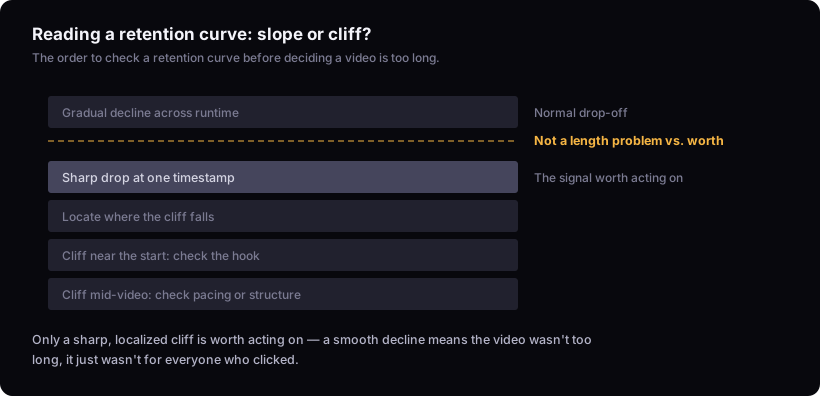
What you're looking for is a cliff: a sudden, sharp drop concentrated at one timestamp rather than spread across the whole runtime. A cliff means something specific happened at that second that pushed people out faster than the rest of the video did. That's the signal worth acting on. If your retention curve is a smooth diagonal line with no cliff, the video wasn't too long — it just wasn't for everyone who clicked it, which is a different problem. For the mechanics of reading the shape, see how to read your youtube retention graph.
Length is a symptom, not a cause
Most "this video was too long" complaints are actually a pacing problem, a weak hook, or a premise that never got clearly stated wearing a length costume. Cutting runtime without diagnosing the actual cause just moves the drop-off point earlier — the cliff doesn't disappear, it relocates.
If the cliff shows up right after the intro, the problem usually isn't the video's total length, it's what happened in the first thirty seconds. Check how to hook viewers in the first 30 seconds before you touch the edit timeline. If the cliff shows up mid-video at a point where the pace slows or the topic drifts, that's a structure problem a shorter runtime papers over rather than solves. Trimming treats the symptom. Fixing the section that caused the drop treats the cause, and it's the only version of the fix that also raises how much of the video, on average, viewers actually watch — worth checking against average view duration on youtube: what it actually measures.
What the algorithm is actually optimising for
YouTube's own documentation ties suggested and search placement to engagement and satisfaction signals, not to a raw watch-time or duration target. Length is not the lever. What length does is create more or less opportunity for the things that actually matter — clear premise, pacing, payoff — to either hold or lose someone.
Chasing a longer runtime because "the algorithm rewards watch time" misreads the mechanism. A ten-minute video that holds attention start to finish and a thirty-minute video that does the same thing are both giving the platform the satisfaction signal it's actually weighing. A thirty-minute video padded to hit a duration target, with a cliff at minute six, gives it neither the runtime credit you were hoping for nor the satisfaction signal that decides placement.
Shorts vs long-form: different question, not a shorter answer
Applying long-form pacing logic to a Short, or Shorts logic to a long-form video, misreads what each format is actually doing. A Short lives in a feed built for continuous swiping — the viewer's starting intent is close to zero and the entire job is to earn the next few seconds, repeatedly, until the video ends. A long-form video is watched with at least some deliberate intent already spent clicking the thumbnail, so the pacing calculus that keeps a Short alive would feel frantic stretched over ten minutes.
If your Shorts aren't holding, the fix rarely has anything to do with trimming a long-form idea down — it's usually a distinct problem with hook and loop mechanics, covered in why your youtube shorts aren't getting views.
A process for setting your own length before you publish
Draft to the point where the premise is fully delivered and nothing the viewer needs is missing — not to a target runtime. Then check that draft's pacing against your retention history: pull up your last several videos with a similar structure or topic and look at where each one's curve actually cliffs, not just its final average.
If your past videos on similar topics consistently cliff around a certain point, that's information about your specific audience's patience for that kind of content, and it's a stronger guide than any published benchmark. Trim to just before where your pattern says people leave, or extend where your pattern shows people were still gaining but the video cut off first. Run the rest of your pre-publish check, including title and thumbnail, against what to check before publishing a youtube video — a length decision made in isolation from packaging is only half the job, since the thumbnail and title set the expectation the runtime then has to satisfy.
Where this method stops working
This tells you where your own past videos lost people, and lets you infer a defensible length range from that pattern. It cannot predict the right length for a video you haven't made yet on a topic or format you have no retention history on. A channel too new to have a reliable pattern gets a starting estimate to test, not an answer — there's no substitute for publishing, watching where that specific video's curve breaks, and feeding it back into the next draft. If your upload cadence is inconsistent, your retention history will be too thin to trust; see how often should you upload to youtube? a diagnostic if that's the deeper issue.
Once you have a length range that survived a few videos, stop treating any single number as fixed. The topic changes, the audience's patience for it changes, and the only reliable check is still the graph.