There isn't one YouTube algorithm. YouTube's own documentation describes separate ranking systems for separate surfaces — search results and suggested/browse videos each use different inputs, so a tactic that helps one can do nothing for the other. Treating "the algorithm" as a single thing is why so much advice contradicts itself.
There isn't one algorithm — there are separate rankings
Search ranking decides what shows up when someone types a query into YouTube's search box. Suggested and browse ranking decides what shows up in the sidebar, the home feed, and autoplay. These are documented as distinct systems with distinct jobs, not two dials on the same machine.
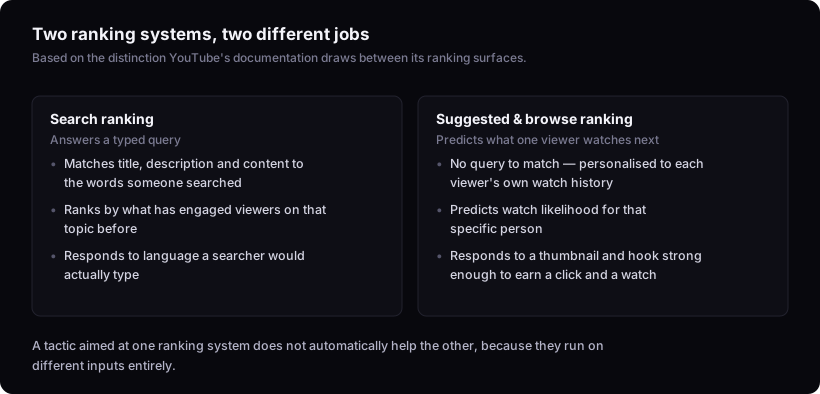
This matters because a lot of advice assumes one system rewards both effort types equally. It doesn't. Optimising a video for search terms someone might type does not automatically make it more likely to be suggested after a different video, because suggestion isn't answering a query at all — it's predicting whether a specific viewer, based on their own watch history, will keep watching.
What actually feeds search ranking
Search ranking uses relevance signals — how well a video's title, description and content match the words someone searched — combined with how well that video and others on the topic have engaged viewers. This is closest to traditional search behaviour: match the query, then rank by what has worked for that topic before.
The practical implication is that a video competing for search traffic should describe itself in language a searcher would actually type, in the title and description, because that's the documented match point. This is a different job from writing a title meant to stop a scroll in a feed — see how to title a YouTube video for that separate problem.
What actually feeds suggested and browse ranking
Suggested video ranking is built around predicted watch likelihood, personalised to each viewer's own history. It isn't matching a query at all — there's no query. It's a bet on whether this particular person, having just watched what they watched, will watch this next.
That's why "gaming the suggested feed" is a different, and much less tractable, problem than ranking for search. There's no string to match. The system is working off aggregate behaviour across a personalised audience, and no single tactic — a keyword, a tag, a posting time — moves that number for everyone at once, because everyone's history is different.
The tags myth, according to YouTube itself
Tags play a minor role at best, according to YouTube's own creator documentation, mostly useful for disambiguating commonly misspelled words in a title. They are not the lever most creators treat them as. YouTube names title, thumbnail and description as the metadata that actually matters for helping a video get found and understood — see do YouTube tags still matter? what they actually do now for the fuller breakdown.
If tags aren't doing the work, the attention has to go somewhere else: a title that states its premise clearly, a thumbnail that reads instantly, and a description that actually describes the video.
Impressions and click-through rate: what they measure and what they don't
An impression is counted when a thumbnail is shown to a viewer on YouTube; click-through rate is the share of those impressions that turned into a click. Both are defined precisely in YouTube Studio's analytics, and neither one is a measure of the video itself — they measure the packaging's performance against whoever saw it. See YouTube impressions vs views: what the pair actually tells you for how the two relate.
YouTube does not publish a universal "good" CTR number, and it can't, because impressions come from wildly different contexts — a home-feed impression to a subscriber and a search-result impression to a stranger are not comparable events. A CTR only means something set against that same video's or channel's own history. If you want the fuller argument for why a flat benchmark fails, read what is a good click-through rate on YouTube?
Why outlier videos look like the algorithm "favouring" something — and usually aren't
A video that vastly outperforms a channel's normal range looks like proof the algorithm picked it for a reason. Usually the more useful question is how far outside that channel's own normal range it actually sits, not what secret the algorithm found in it. We treat roughly three times a channel's recent normal as the point where a video counts as a genuine outlier, with two times only mildly interesting and ten times or more exceptional, because the raw view count means little on its own — the same number is a breakout for one channel and disappointing for another.
That reframes the question. Instead of asking "why did the algorithm love this," ask "how far is this from what this channel normally does, and has anything like it happened before." For the mechanics of running that comparison, see what is an outlier video on YouTube? and how to find outlier videos in your niche
What this means for what you actually control
The two-system model gives you a checklist, not a mystery to solve. For search traffic: does the title and description match language someone would type. For suggested traffic: is the thumbnail and hook strong enough to earn a click and a watch once it's shown, since that's the only lever a personalised prediction system responds to at all.
Stop trying to satisfy one algorithm and start asking, for each video, which surface it's actually trying to win on — then check the metric that surface actually uses. The metric glossary and the published methods lay out the definitions and formulas behind these numbers in full.
What this article can't tell you
This article reports what YouTube's public documentation says about ranking inputs. It cannot reveal exact ranking weights, model internals, or confirm that any specific tactic moved any specific channel's numbers, because YouTube doesn't publish that level of detail and no testing evidence was used to write this. Anyone claiming to know the exact weighting is guessing.