There is no universal best time to post on YouTube, and no public data source can tell you your specific best hour. Publish time is not a ranking input for search or suggested videos. If a video underperforms, the clock it went out on is very unlikely to be the reason, and chasing one wastes time you could spend on the parts of a video that do move distribution.
Why "best time to post" keeps coming up
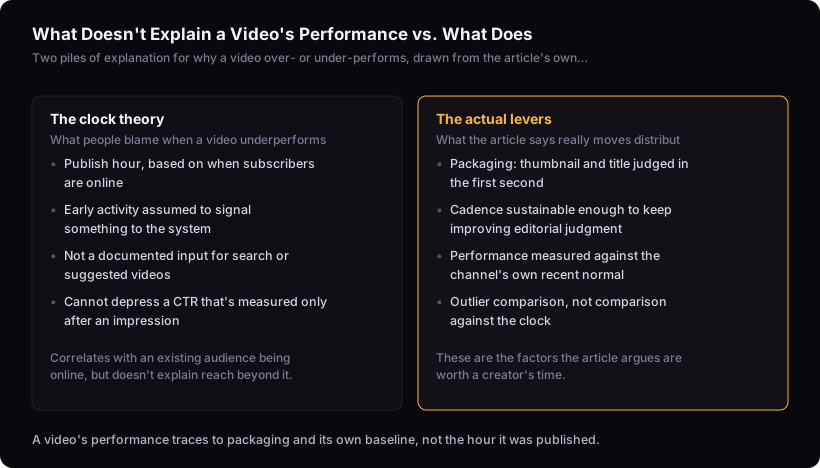
The theory feels intuitive: post when your audience is awake, and more of them see it fast, and that early activity signals something good to the system. That's a real correlation in one narrow sense — if your subscribers happen to be online, they may watch sooner. But sooner is not the same as more, and more early watching is not the same as more total distribution. The theory conflates "when my existing audience happens to be online" with "what causes YouTube to show this video to people who don't already follow me." Those are different mechanisms, and only the second one explains why a video takes off.
What YouTube's documentation actually says drives distribution
YouTube's public guidance on how videos get surfaced points to content and viewer signals, not a clock. For search, it's about how well your title, description and content match what someone typed. For suggested videos, it's about what a viewer is likely to watch next based on their history and the video's performance with similar viewers. Neither of those systems, as YouTube documents them, references when a video was published. What they do reference is engagement once the video is in front of people — which puts the weight back on packaging and content, not scheduling.
Where a posting-time theory breaks down against impressions and CTR
Impressions and CTR are both defined around what happens once a video is shown, not when it was shown. An impression is your thumbnail appearing somewhere a viewer could click it; CTR is how often they click when it does. If your click-through rate is weak, that's a thumbnail-and-title problem being evaluated against whoever saw it — not a symptom of publishing at 3pm instead of 7pm. Time of day cannot depress a click-through rate that is measured entirely on what happened after the impression already occurred. If you want to see whether your packaging or your reach is the real issue, start by reading impressions against views rather than against the clock.
What actually explains why a video takes off early or doesn't
Two videos from the same channel, posted at the same time of day, can perform completely differently — which on its own rules out the clock as the deciding factor. What usually separates them is how the video performs against that channel's own recent normal, not the hour it went live. This is the logic behind treating a video as an outlier: judge it relative to your own baseline, because a video that looks big in isolation might be ordinary for that channel, and one that looks small might be a real standout. We treat roughly 3x a channel's recent normal as the point where a video counts as a genuine outlier, with 2x worth a second look and 5x or higher a strong result. None of that comparison involves publish time. It's the video against itself, over time.
The controllable levers worth your time instead
Cadence, consistency and packaging have actual reasoning behind them; a posting-time chart does not. Consistency matters more than hitting an arbitrary slot, and quality matters more than either. We publish at the fastest cadence a channel can sustain without weakening the idea, the title, the thumbnail or the video itself, because newer channels gain from the reps that build editorial judgment, while established channels have more to lose than gain by trading quality for a schedule. If you're unsure what pace is sustainable for where you are right now, this is worked through in more detail in a diagnostic on upload frequency.
Packaging is the other lever, and it's the one people skip while hunting for a magic hour. We check a thumbnail at actual feed size on a phone and give it under a second, because that's roughly how long a feed actually gives it — in that second we should know where the eye goes, understand the visual premise, and feel some curiosity, and if it needs study instead, it's too complicated. Titles follow a related logic: we trust clarity paired with one open question over anything vague or fully resolved, using shapes like comparisons, extremes, consequences, contradictions or transformations, because clarity without curiosity gets scrolled past and curiosity without clarity gets ignored. A full pass through packaging before you hit publish is laid out in what to check before publishing a video, and the thumbnail specifics are covered in how to make a thumbnail that gets clicks.
A simple test if you still want to check your own upload times
If you want to look at your own history rather than trust a generic chart, that's reasonable — it's just not the same claim as "there's a best time." Pull your last 15-20 uploads, note the day and hour each went live, and compare each video's performance against your own recent normal rather than against each other in isolation. If a pattern shows up across several uploads at a similar time, write it down. If it only shows up once, it's probably noise. Even then, treat it as a hint about your own audience's habits, not a rule that would transfer to another channel or another niche — the pattern, if there is one, is specific to you.
What this can't tell you
This reasoning follows from YouTube's published documentation and general outlier-analysis method, not from any first-hand test of posting times or measured performance data. No public data source ties publish time to distribution outcomes, so nothing here can hand you a specific best hour to hit publish. If a video flops, the honest first move is to check packaging and baseline performance, not the clock — and if you're still not sure why one video did numbers and another didn't, that's often unknowable with the data any creator has access to.