There is no method that gets you to 1000 subscribers on a fixed schedule, because that number is a Partner Program eligibility threshold, not a growth strategy — but it does have a shape you can act on. Reaching it comes down to three things happening in sequence: a premise narrow enough that each video's packaging is a repeat of the last one's problem rather than a new invention, a title and thumbnail that make a specific promise, and enough uploads under that same premise for the viewer who watches one video to already expect what the next one covers. Skip the narrowing and every video re-teaches a stranger who you are. Skip the packaging and even a good video underperforms its own quality. Skip the reps and you never get enough attempts for the first two to compound. The rest of this article works through each of those three in the order a new channel actually hits them.
Why 1000 subscribers is a monetisation number, not a growth strategy
1000 subscribers plus a watch-hour threshold is YouTube's documented gate for Partner Program eligibility. It is not a number the recommendation system is trying to help you reach, and there is no evidence it changes how videos get surfaced before or after you cross it.
That distinction matters because it changes what you should be measuring. A creator fixated on the subscriber count is watching a number that moves for reasons mostly outside their control — some subscribers churn, some never watch again, some subscribed for a video they'll never see the follow-up to. A creator fixated on whether each new video is better packaged and better hooked than the last is watching something they can actually act on. Subscriber count is downstream of that. It is a lagging indicator, not a lever.
What actually converts a viewer into a subscriber
A viewer subscribes when a video makes a clear enough promise that they want the next one before they've finished this one. That means the click-to-watch decision and the watch-to-subscribe decision are solved by mostly the same craft: a premise the viewer understands instantly, and a reason to think there's more where that came from.
Two things do most of that work. The title needs to state its premise clearly while withholding the outcome — comparisons, extremes, consequences, contradictions and transformations are title shapes that keep working because each one commits to a promise without answering it, and vague or overstuffed titles keep failing for the opposite reason. A weak title states a topic ("my morning routine"); a working one commits to a promise it doesn't resolve ("the one habit that wrecked my morning routine" is a consequence shape, "the internet's favourite morning routine, tested for a week" is a transformation shape). Notice neither tells you the outcome — that gap is what makes the click necessary. How to write YouTube titles that get clicks goes further into rewriting weak drafts. The thumbnail has to survive the speed it's actually judged at: a viewer scrolling a feed gives it well under a second, so it needs to be legible at phone size before it needs to be clever. If you have to study a thumbnail to understand it, it has already lost. That's covered in more detail in how to make a YouTube thumbnail that gets clicks.
Neither of these guarantees a subscribe. What they do is put a viewer in the state where subscribing is the obvious next action, which is the only state subscribing ever comes from.
Why asking for subscribes rarely moves the number
A verbal reminder to subscribe changes almost nothing about whether someone does, because the decision was already made by the video itself. If the content delivered on its premise, a "please subscribe" is unnecessary. If it didn't, the reminder doesn't fix that.
Worse, tactics built around chasing the subscribe button directly — sub-for-sub arrangements, engagement pods, coordinated "like and subscribe" campaigns — work against what the platform's suggested and search systems are actually trying to do, which is match viewers to videos they will watch, not to channels they will follow. Optimising for follow behaviour when the system optimises for watch behaviour is optimising for the wrong metric, and it's also the kind of manipulated engagement that YouTube's policies treat as a problem rather than a growth hack. None of it should appear in your process.
If a video isn't converting viewers into anything — not views, not subscribers — the fix is almost never a stronger call-to-action. It's worth ruling out the more basic explanations first, which is what why your YouTube video isn't getting views: a diagnostic walks through.
The reps that compound: consistency versus frequency
A forced upload schedule that produces a weaker idea, a rushed title or a thumbnail nobody tested is a worse trade than skipping that slot. We publish at the fastest cadence that doesn't weaken the idea, the title, the thumbnail or the video itself, and we treat that ceiling as personal to each channel rather than a fixed number to hit. Newer channels benefit more from pushing that ceiling, because the judgement that makes packaging good comes from doing enough reps to see what works and what doesn't. Established channels have less to gain from squeezing in an extra upload and more to lose from letting quality slip to hit one.
This is also why "post more" is bad advice on its own. Frequency without quality produces more videos that don't convert, at a faster rate. If your cadence question is more specific than that — how many uploads a week is actually sustainable for where you are — how often should you upload to YouTube? a diagnostic works through it in more detail.
On niching down: do it before you're chasing 1000, not after. A channel with a clear, narrow premise makes the title-and-thumbnail problem easier to solve repeatedly, because you're solving a version of the same problem each time rather than reinventing the premise every upload. Waiting until after 1000 subscribers to narrow the channel means a chunk of your early subscribers followed a different premise than the one you settle on, which doesn't help either number.
Using outlier videos in your niche to find what earns subscribers
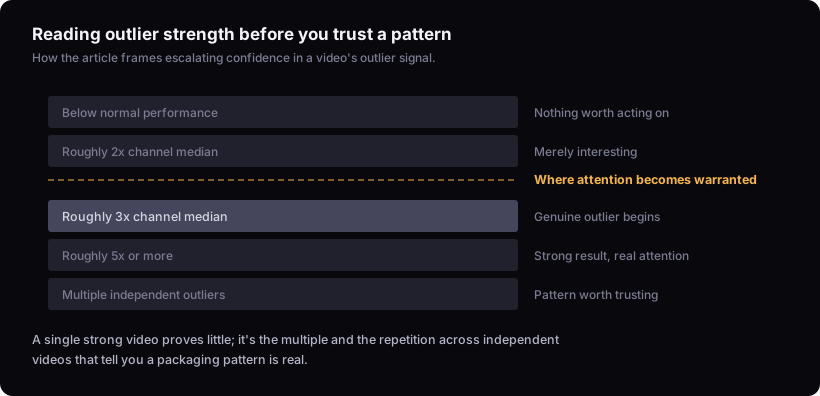
An outlier is a video that did unusually well against that channel's own normal, not one with a large view count in absolute terms — a video with a modest view count can be a real outlier on a small channel, and a much bigger number can be nothing special on a channel that regularly gets more. About three times a channel's recent normal is where we start treating a video as a genuine outlier, with two times as merely interesting and five times or more as a strong result worth real attention. What is an outlier video on YouTube? covers the mechanics if the concept is new.
Finding one outlier tells you little on its own — it could be luck, a trending topic, an algorithm fluke. We treat three independent outliers as worth paying attention to, and five or more, ideally spread across different channels, as the point where we start trusting that a packaging or hook pattern is repeatable rather than a coincidence; we also check similar videos that underperformed, because a pattern only means something if attempts without it did worse. That last step is easy to skip and it's the one that stops you copying something that only worked once.
If you want to build this habit into your process rather than doing it by eye, how to find outlier videos in your niche sets out a repeatable way to scan for them, and pairing that with a sense of how first thirty seconds keep a viewer watching helps translate what you find into your own hook — see how to hook viewers in the first 30 seconds. When you're short on what to make next, the idea generator is one place to turn outlier patterns into your own video ideas rather than starting from a blank page.
What this approach can't do
This reasons from published YouTube documentation and general patterns in what makes videos convert viewers into subscribers. It cannot tell you how long your specific channel will take to reach 1000 — that depends on your niche and upload history — but the sequence above (narrow premise, honest packaging, repeated attempts) is the same one to work through regardless of the timeline. It is not a tested case study of a channel that used it, and nobody — including us — can predict a subscriber count from a plan. What it can do is point you at the same handful of decisions that matter at every stage past 1000 too, so the work doesn't need to change once the gate is behind you.
The next thing to do isn't to check your subscriber count again. Pull up your last three uploads and compare, for each one, what the title or thumbnail implied the video would deliver against what the video actually opened with in its first thirty seconds. Where the two don't match, that's the packaging to redo before your next upload, not the video to reshoot.