To analyse a competitor's YouTube channel, follow one rule above all the others: keep what you measured separate from what you concluded. Almost every competitor teardown you will read blurs the two — a real view count sits next to a confident claim about why it happened, and the number lends its credibility to the claim.
What you can measure on a competitor's YouTube channel from outside
Short list. Everything on it comes from public data:
- View counts on every public video
- Publish dates, so you can see cadence and how it changed
- Duration, which lets you separate Shorts from long-form
- The channel's own median, which turns raw views into a comparable ratio
- Title and thumbnail as published
- The transcript, where captions exist
That is genuinely a lot. It is also everything.
What you cannot see, and nobody else can either
- Retention. No curve, no average view duration, no drop-off point.
- Click-through rate. The single number most competitor "analysis" implies it knows.
- Traffic sources. Whether a video came from browse, search, an external link or a shout-out.
- Revenue. No RPM, no sponsor figures.
- Intent. Whether an unusual video was a deliberate experiment or an accident.
Any tool that reports these for a channel you do not own is modelling them, and a model presented without that word is the thing to walk away from.
The order to work in
1. Establish the baseline before you look at anything else. Take the last 30–50 uploads, split Shorts from long-form, and take the median of each. Skip anything from the last two weeks — it has not settled. Without this step every conclusion you draw is really a statement about how big the channel is.
*2. Find what overperformed that baseline.* Divide each video by its group's median. The 2×–8× band is where something repeatable probably happened; past roughly 15× you have usually found a low denominator rather than a remarkable video. The full arithmetic is here.
3. Read the packaging before you watch anything. Look at the title and thumbnail of an outlier next to the four videos published either side of it. What is structurally different? A face where there usually is none, a number where there usually is a claim, a question where there are usually statements. This is where most transferable findings actually are.
4. Then watch the first thirty seconds. Not the whole video, and not yet. You are checking one thing: does the opening confirm what the packaging promised? Mismatch here is the most common reason a well-packaged video underperforms, and you can spot it in half a minute.
5. Read the transcript for shape, not content. Where does it re-hook? How often does it open a loop and close it? Is there a payoff, and where does it land relative to the runtime? The subject is rarely the transferable part. The shape usually is.
6. Write down what you could not tell. This is the step everyone skips and the one that keeps the exercise honest. "I cannot tell whether this came from browse or from an external link" is a real finding.
The two-column habit
For every claim you end up with, put it in one of two columns:
| Measured | Inferred |
|---|---|
| 4.2× its channel's long-form median | The thumbnail is doing the work |
| Published Tuesday, 11 days after the previous upload | The cadence break helped |
| 14 minutes, against a 9-minute median | The longer format suited the subject |
| First loop opens at 0:12 and closes at 6:40 | The delayed payoff held retention |
Keeping them apart does not make the right-hand column less useful. It stops you spending a month on an inference you would not have bet on if you had seen it labelled.
Where this stops working
A channel that changed format recently has no usable baseline. Neither does one that posts irregularly, or one with fewer than a handful of settled uploads. Those are often the channels you most want to understand, and the honest output there is that you cannot yet.
Their audience is not your audience. A format that worked for a channel with a five-year-old subscriber base may transfer to yours or may not, and the analysis cannot tell you which. That is a judgement, and it stays yours.
Doing it faster
The video teardown runs this on any public URL and returns the two columns literally separated, ending with what it could not assess rather than filling the gap.
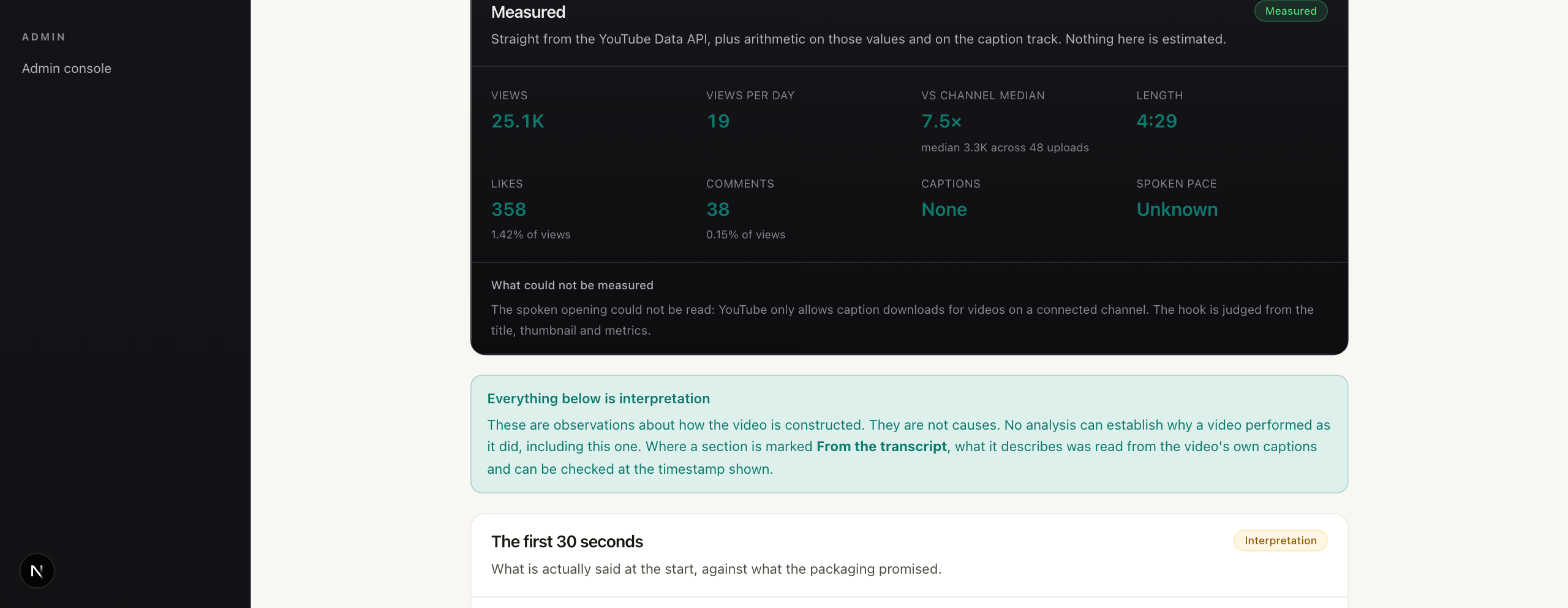
For watching a set of channels over time rather than one video once, the channel watchlist re-checks them daily against each channel's own median and says which baseline produced each number.