The reader searching this already knows how to send a DM. What they need is how to pick who gets the DM, and how to know afterward whether the collab actually did anything. Most advice on this topic covers etiquette and outreach scripts and stops there, which is the easy half of the problem.
Why most collaboration advice stops at the handshake
Most guides on this topic treat getting the collab as the finish line. They cover how to write a friendly message, how to split the work, how to be a good guest. None of that is wrong, but it skips the two decisions that actually determine whether a collaboration was worth doing: who you approach, and how you judge the result once it's live.
Picking a partner because you like their channel, or because they're roughly your size, is a guess dressed up as strategy. And measuring success by "did the video do numbers" ignores that two channels can have wildly different normal ranges — a video that's a flop for one creator is an outlier for another. This article treats partner selection as a research task and result-judging as a measurement task, because both are things you can actually reason about before and after the fact, instead of just hoping the collab lands.
Vetting a partner like a competitor, before you pitch them
Treat a prospective collaborator's channel the way you'd treat a competitor: pull up their recent uploads, their format, their pacing, and their audience signals before you write a single word to them. You're not looking for reasons to be a fan. You're looking for evidence that a collaboration between your channel and theirs would actually work.
The process is the same one used to analyse a competitor's YouTube channel: look at their last several months of uploads, not just their best video ever. A channel's single viral hit tells you almost nothing about what a partnership with them would look like day to day — you want their normal output, their typical structure, and whether their recent trajectory is flat, growing, or declining. A channel that peaked two years ago and hasn't repeated it since is a different collaboration bet than one that's been quietly stacking solid uploads.
Check format compatibility specifically. If your videos are 20-minute scripted explainers and theirs are fast-cut reaction content, a joint video will feel like two different shows stitched together, and that's a real cost even if the audiences overlap well. Look at what their audience responds to in comments — not the count of comments, but what people are actually asking for or praising, because that tells you what a guest appearance from you would need to deliver.
This is research you do quietly, before any outreach, using the same lens as youtube competitor analysis: beyond the one-channel teardown. If you're tracking several prospective partners over time rather than checking once, a running list like the channel watchlist keeps that comparison somewhere other than your memory.
What audience overlap actually means, and why too much or too little kills a collab
The right amount of audience overlap for a collaboration is partial, not total and not zero. This is the part most advice skips entirely, and it's the actual mechanism behind whether a collab brings either channel new viewers.
If your audiences are nearly identical, a collaboration has nothing to offer either side — you're both showing your existing viewers a video they'd have watched anyway, with no new-audience effect for either party. If your audiences don't overlap at all, neither fanbase has a reason to care about a stranger showing up in a video they came to see for a different reason. The useful zone is in between: audiences that share an interest or a demographic but aren't already watching the other channel. That gap is where a collaboration actually introduces one set of viewers to a channel they wouldn't have found otherwise.
You can't measure this with real precision from outside either channel — you don't have access to either channel's actual audience overlap data. What you can do is infer it from public signals: shared topics, similar comment-section vocabulary, overlapping video ideas covered independently by both channels, similar audience demographics implied by content style and platform presence. If you're unsure whether a niche is even adjacent enough to test this reasoning on, working out how to find your youtube niche (without guessing) first will sharpen what "adjacent" means for your specific channel before you start evaluating partners against it.
Formats collaborations take, and matching format to goal
Different collaboration formats serve different goals, and picking one without naming the goal first is how a collaboration ends up satisfying nobody. There are a handful of structures that repeat across the platform, and each is suited to a different outcome.
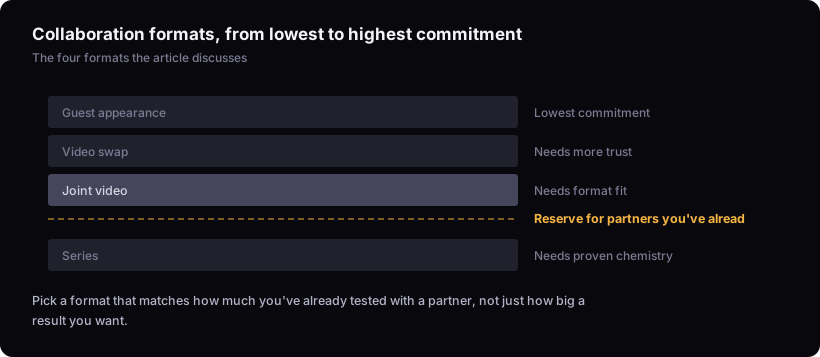
A guest appearance — you show up in their video, or they show up in yours, for a segment rather than the whole runtime — is the lowest-commitment format and works best for a one-off view lift or a first introduction between audiences. It doesn't ask either channel to change its format, and it's the easiest to say yes to, which makes it a reasonable first collaboration with a new partner.
A video swap, where each of you makes a full video for the other's channel, asks for more trust and more format flexibility, but it exposes each audience to more of the other creator's actual work rather than a cameo. It suits a goal of genuine subscriber discovery, because a full video gives a new viewer enough to decide whether they want to subscribe, where a short guest segment often doesn't.
A joint video, filmed and released together, usually on one channel or cross-posted, works when the content itself benefits from two perspectives — a debate, a reaction, a shared challenge. It's the format most dependent on genuine format compatibility, because you're both on screen for the same runtime.
A series, run across multiple videos over weeks, is the highest-commitment format and the only one that can build a repeat-viewing habit between the two audiences rather than a one-time exposure. It's a bad first collaboration with someone you haven't worked with before, because it assumes chemistry and reliability you haven't tested yet.
| Format | Commitment | Best suited to |
|---|---|---|
| Guest appearance | Low | First contact, one-off view lift |
| Video swap | Medium | Subscriber discovery |
| Joint video | Medium-high | Content that needs two perspectives |
| Series | High | Building a repeat audience habit |
Writing a pitch a busy creator will actually read
A pitch that gets read is specific about what's in it for the other channel, not just what's in it for you. Generic praise — "I love your content" — is the first thing a creator with an inbox learns to skim past, because it could have been written about any channel.
The pitch that works instead leads with the research from the vetting step: name a specific recent video of theirs, say what you think it did well, and connect that directly to a concrete idea for why a collaboration would work for their audience specifically, not just yours. "Your last three videos on [specific topic] got strong engagement in the comments around [specific angle] — I think a video where we cover [specific angle] together would land well with that audience" reads as someone who did the work, because it demonstrates you actually watched their recent uploads rather than their highlight reel.
Keep the ask small and concrete. Propose a specific format, not "we should collab sometime." A vague invitation forces the other creator to do the planning work of turning your interest into an actual video, and that's exactly the kind of open-ended ask that gets left unanswered in a busy inbox.
Judging the result: outlier logic applied to collab videos
Whether a collaboration worked is a question you answer against each channel's own normal, not against a shared number. The same channel's recent view range that governs judging any other video applies here: what looks impressive as raw views can be an underperformer for one channel and a real outlier for the other, and treating the collab video like any other upload avoids the trap of one side declaring victory off a number that only looks big out of context.
The working rule we use for outlier judgement is that a video performing around three times a channel's recent normal is worth paying attention to — two times is interesting, five times is strong, ten times or more is exceptional. That's a matter of judgement tuned to a channel's own patterns, not a fixed measurement, but it gives both sides in a collaboration a real way to check the result instead of eyeballing a raw number. Run the collab video's performance through the same lens you'd use for what is an outlier video on youtube?, separately for each channel, because a collaboration can be an outlier for one partner and unremarkable for the other — that's not a failed collab, it's just asymmetric benefit, and it's worth knowing which way the asymmetry ran before you plan the next one.
Watch subscriber gain and comment overlap too, not just the view count on the day it published. A guest segment that spikes views but produces no subscriber movement and no comments from the partner's regular audience is a sign the audiences didn't actually mix, even if the raw number looked fine.
Where cross-promotion goes wrong
The most common collaboration failure is audience mismatch that wasn't caught during vetting — the two channels looked compatible from the outside but the actual viewer interests didn't line up, and the video underperforms on both sides despite good execution. This is why the vetting step matters more than the outreach template: no pitch structure fixes a bad pairing.
The second failure is one-sided exposure, where one channel's audience is meaningfully larger or more engaged and the smaller partner gets a real lift while the larger one barely registers the video among its own uploads. This isn't automatically a bad collaboration — asymmetric benefit is normal — but it becomes a problem when it's not acknowledged going in, because the larger channel ends up feeling like they did a favour rather than a trade.
The third is exposure with no retention: a guest segment or swap brings in viewers who watch that one video and never return, because nothing in the video gave them a reason to check the rest of the channel. This usually traces back to the guest content being disconnected from what the host channel normally makes, which is why format compatibility from the vetting step matters as much as audience overlap. If a collaboration underperformed and you're trying to work out which of these it was, running it through why your youtube video isn't getting views: a diagnostic separates a distribution problem from an audience-fit problem.
What this can't tell you
This reasons from public channel data and general platform mechanics, not from any collaboration actually run. It can't tell you how a specific pitch will land, what a prospective partner's private analytics show, or whether scheduling and personal chemistry will make a deal come together — those are the parts no outside analysis reaches. Audience-overlap judgments here are inferred from public content and recent uploads, not measured directly, because that data isn't available to either side before the collaboration happens. Treat the vetting process as a way to avoid an obviously bad pairing, not a guarantee of a good one.