A YouTube playlist strategy is a deliberate decision about which videos to group so that watching one makes a viewer likely to watch the next, not a decision about how to file uploads into folders or which keywords to put in a playlist title. That distinction is the whole subject. Most advice on this topic treats playlists as a homepage-tidying task or a metadata trick. The more useful way to think about a playlist is as a bet on session behaviour: you are choosing which videos belong next to each other because a real viewer would plausibly go from one to the other, not because they share a subject label.
What a playlist strategy actually means
A playlist strategy means choosing playlist membership based on predicted viewing behaviour rather than topical similarity. Two videos can be about the same subject and still be a bad pairing if nobody who finishes one wants the other next. Two videos can be about different subjects and be a great pairing if they share an audience mood or a natural next step — a beginner tutorial followed by the troubleshooting video for the mistake beginners always make, for example.
This is different from organising your channel page. Organising is about making your upload history browsable for someone who already knows they like you. Strategy is about shaping what happens automatically, in a session, for someone who does not yet know that. Both are legitimate jobs. Only one of them is what people usually mean when they ask about "playlist strategy," and it is the one this article covers.
How playlists connect to suggested videos
Playlists influence suggestions because grouping videos together is one of the clearest signals you can give about what tends to get watched next after a given video. YouTube's own documentation describes suggested videos as being ranked using signals including a viewer's watch and search history and what similar viewers have watched — it is a system built to predict the next likely watch, not to match subjects. A playlist is one of the few structural signals a creator controls that speaks directly to that prediction: it says, explicitly, "people who watch this tend to want that."
This reframes the whole exercise. The question is not "what folder does this video belong in" but "if someone just finished watching video A, is video B a plausible next click." A playlist built around a real viewing pattern strengthens a signal the suggestion system is already trying to detect. A playlist built around a subject label, with no real behavioural link between the videos in it, adds noise the system has to work around.
None of this is something YouTube publishes a formula for, and nobody outside YouTube can see how heavily any single playlist influences a given suggestion slot. What is documented is the goal of the system — predicting next watch from behavioural signals — and that goal is what a playlist strategy should be built to serve.
Choosing what to group: topic vs. viewer intent
Group videos by what a viewer would plausibly watch next, not by what a video is about. Topic is a reasonable starting filter but a poor final one. Two videos on the identical topic aimed at different intents — one for someone deciding whether to start, one for someone already three months in — often do not belong in the same playlist, because the person who wants one is unlikely to want the other right after.
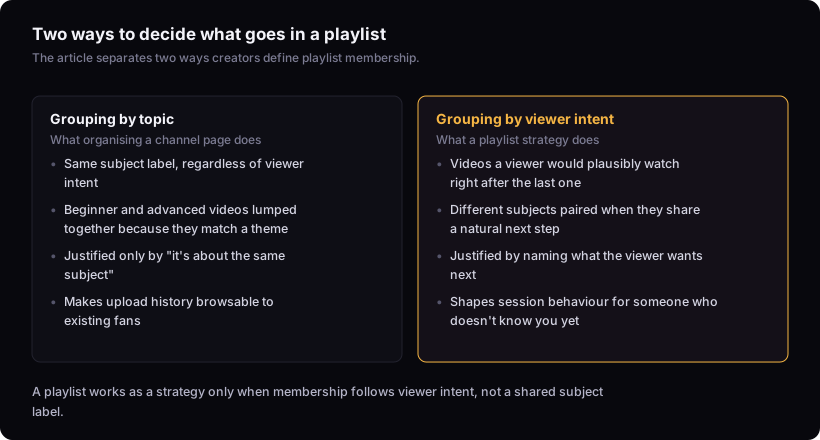
A useful test: picture the specific viewer who just finished the first video. What do they now want — reassurance, the next step, a deeper version of the same idea, or a related problem they're about to hit? If you can name that want, you know what belongs next to it. If your answer to "why is this video in this playlist" is only "it's about the same subject," that is the sign the playlist is organised by label instead of by intent, and it is unlikely to be doing the session-extension job.
This is also where the case for niche clarity connects. A channel with a scattered subject range will find grouping by intent harder, because there are fewer videos that share both a topic and a plausible next-watch relationship.
Does order inside the playlist matter?
Order matters because it decides which video autoplay offers next, and that is a separate decision from which videos belong in the playlist at all. Membership answers "does this video belong with these others." Order answers "given that it belongs, when should it play."
Two common ordering logics work for different reasons. Easiest-to-hardest suits instructional content, because a viewer who understood video one is the right audience for video two, and the reverse order would lose them. Narrative or chronological order suits anything where later videos depend on context set up earlier — a series, a build, a story told in parts. Neither is universally correct; the ordering logic should match the actual relationship between the videos, and if there isn't one, that's a sign the videos may not belong together at all.
Get the membership decision right first. A well-ordered playlist of loosely related videos is still a loosely related playlist.
Where titles, descriptions and tags fit in a playlist strategy
Playlist titles and descriptions matter far less for discovery than the packaging of the videos inside the playlist, and tags matter least of all. It is worth naming this directly because a lot of playlist advice treats the playlist's own metadata as the lever to pull — keyword-load the title, stuff the description, tag it heavily. That is the same mistaken model applied a level up: it treats a playlist as a document to be optimised for search rather than a structure that shapes what gets watched next.
Tags play a minimal role in how videos and playlists actually get found, and titles, thumbnails and descriptions do the real discovery work at the video level. A playlist's real strategic value comes from its membership and order — the mechanism this whole article is about — not from how its own title is worded. Write a playlist title and description that clearly and accurately describes what's in it, the same way you'd approach writing any video description, and put the strategic effort into which videos go inside.
Common playlist mistakes that waste the mechanism
The three mistakes below all break the same thing: the link between one watch and a plausible next one.
Too broad. A playlist covering everything on a general theme — "all my videos about cooking" on a channel that covers baking, knife skills and restaurant reviews — groups videos that don't actually predict each other. A viewer who watched the knife skills video isn't reliably the person who wants the restaurant review next. Breadth dilutes the next-watch signal to the point where the playlist isn't really predicting anything.
Too narrow. A playlist with one or two videos in it can't do the job at all — there's no meaningful "next" to offer, and a one-item playlist carries no real information about a viewing pattern. If a playlist can't hold at least a few videos with a genuine viewing relationship, it likely isn't a playlist yet, just a placeholder.
Dumping the entire upload history in. A single playlist containing every video a channel has ever made treats "watched by the same audience at some point" as equivalent to "one video plausibly leads to the next," which is a much weaker and often false claim. It's organisation, not strategy, and it doesn't strengthen any specific next-watch signal because it doesn't commit to one.
Each of these mistakes is really the same error at different scales: substituting a topic or ownership label for an actual behavioural relationship between two specific videos.
What this reasoning can't tell you
This is based on YouTube's public documentation about how suggested videos and search ranking generally work. It cannot tell a specific channel which exact videos to group together, predict how a particular playlist will perform, or verify the precise mechanics of how a playlist affects ranking — YouTube does not publish playlist-specific ranking details. Treat the guidance here as a way to reason about membership and order, not as a formula with a guaranteed outcome.
What to do next
Look at your last ten uploads and ask, for each one, which other video on your channel someone would plausibly want right after finishing it. If you can answer that for three or four pairs, you have the start of a playlist built on the actual mechanism instead of a subject label. If retention inside those videos is also uneven, reading the retention graph alongside this exercise will tell you whether the problem is packaging, pacing, or sequencing — three different fixes that get confused with each other constantly. For the rest of the upload page beyond playlists, see the packaging method, and for term-by-term definitions, check the glossary.