Testing a thumbnail means two different checks that happen at two different times: before upload, you're testing whether the thumbnail-and-title pair communicates fast enough to survive a feed; after upload, you're reading how its click-through rate moved against your own channel's recent history — a data point to accumulate, not a verdict to act on alone. Most advice on this topic only covers the second one, which leaves you with nothing to check before you've already spent an upload on a guess.
Two kinds of testing, and why conflating them fails
Pre-publish testing asks a legibility question: can a stranger read this thumbnail in the fraction of a second a feed gives it? Post-publish testing asks a performance question: did this thumbnail, alongside its title, get clicked more or less than your recent normal? These are different failure modes. A thumbnail can pass the legibility check and still get a flat CTR because the topic doesn't interest anyone that week. A thumbnail can fail the legibility check and still get lucky clicks because the title carried it. Treating "testing a thumbnail" as a single step — publish it, wait, read the CTR — skips the only check you can actually run before the video is live, and it's the check that catches the more common mistake: a thumbnail nobody can parse.
The one-second, actual-size check
Before upload, view the thumbnail at the size it will actually appear at, on a phone, in a feed — not full-screen on a monitor where every detail is visible and nothing needs to compete for attention. Give yourself under a second. In our own process we check for three things in that second: where the eye lands, whether the visual premise is clear, and whether there's a pull of curiosity to click through. If you find yourself studying the image — zooming in, reading small text twice, working out what the picture is of — that's the failure sign. The fix is usually to remove an element, not add one.
This check has no score and needs none. The verdict is still a single pass-or-fail: did the premise land inside that second? Where the eye went and whether anything pulled are how you explain a fail, not separate scores. Run it on a few thumbnails side by side at actual size and the failures are usually obvious without any further analysis.
Why CTR has no pass mark
There's no published benchmark for a good CTR, and no meaningful comparison across channels; the only comparisons that mean anything are against your own channel's own recent videos, made carefully. YouTube's own documentation on this doesn't give a target number, and that omission is deliberate rather than an oversight: CTR depends on where a video is surfaced (home feed, search, suggested), a channel's existing audience relationship, and the topic's baseline interest, all of which vary enough between videos and between channels that a shared benchmark would mislead more than it would inform.
That means reading CTR as a scoreboard — "is 6% good?" — is answering a question that has no honest answer. The only version of the question that does have an answer is relative: is this number higher or lower than what this channel normally gets? For more on why a single CTR figure resists comparison, see what is a good click-through rate on youtube?
What impressions and CTR are actually counting
An impression is counted when a thumbnail is shown for a continuous period and is at least half visible on screen — a scroll-past doesn't count, and neither does a sliver of thumbnail at the edge of a screen. CTR is the ratio of clicks to those impressions. Knowing this matters because a swing in CTR can come from a change in where the video is being shown, not from the thumbnail at all: more search impressions versus more suggested impressions will move the number even if nothing about the packaging changed. For the mechanics of how impressions and views relate to each other, see youtube impressions vs views: what the pair actually tells you
Testing packaging, not just the image
Title and thumbnail are read together, not separately, when someone decides whether to click. A viewer sees both at once in a feed row, and each does part of the job: the thumbnail usually carries the visual premise, the title usually carries the specific hook or the open question. That means testing a thumbnail in isolation from its title will miss the two most common failure combinations: a strong image undercut by a vague or duplicate title, and a strong title with no visual to back it up.
Practically, this means your pre-publish check should include the title next to the thumbnail, at the same actual size, read together — not the thumbnail alone with the title added later as an afterthought. If you're testing new titles as part of this pass, see how to title a youtube video (with working examples) and for the design side, designing the thumbnail covers the same packaging logic from the image end.
A repeatable before/after testing process
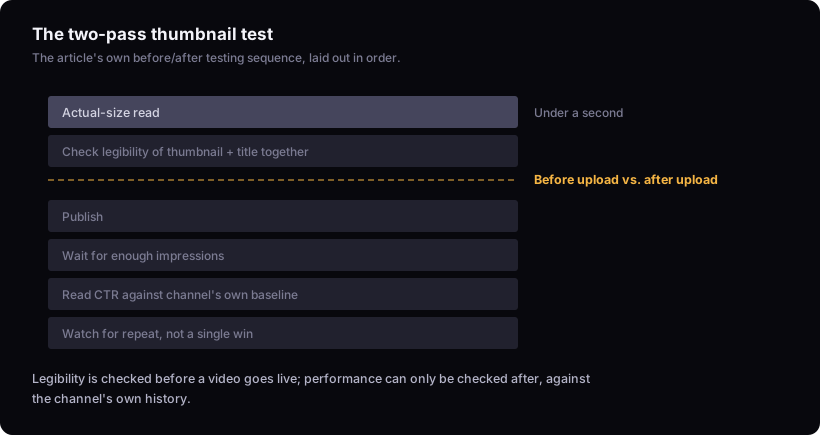
The sequence is the same every time, and it separates the two checks so neither one contaminates the other:
| Step | When | What you're checking | What counts as a fail |
|---|---|---|---|
| Actual-size read | Before upload | Legibility of thumbnail + title together | You need more than a second to understand it |
| Publish | — | — | — |
| CTR against baseline | After enough impressions | Direction of movement vs this channel's recent history | Nothing — it's a data point, not a verdict |
The last row matters more than it looks. The standard we work by: a CTR reading only means something set against that same channel's own recent numbers, the way an outlier is only meaningful relative to a channel's own normal rather than a raw count. In our experience one video moving on its own isn't a pattern — watch for whether it repeats, and worth checking against a similar video that didn't move, so a single win doesn't get mistaken for a repeatable format. If you want a fuller pre-upload sequence that includes this check alongside title and metadata review, see what to check before publishing a youtube video. If you'd rather have a tool run the actual-size check for you, the thumbnail designer previews at feed size before you publish. For the rest of what goes on the upload page around the thumbnail and title, see the rest of the upload page
Where this stops working
This method tells you whether a thumbnail is legible at speed and whether its CTR moved relative to a channel's own recent history. It cannot tell you why a viewer clicked, and it cannot cleanly isolate the thumbnail's contribution from the title's, because they're read together and the click decision doesn't separate them. It cannot give you an objective "good CTR" number, because no such number exists in YouTube's published documentation — any CTR reading is only meaningful measured against that same channel's own recent history, not against another creator's numbers or a general figure found online. If your baseline itself is noisy or your channel is new, even a relative reading will be unreliable for a while.
Our rule on cadence: publishing more often gives you more data points to build that baseline from, but only if the extra reps don't come at the cost of a weaker idea, title or thumbnail — the fastest sustainable cadence beats a fixed schedule that forces rushed packaging.