You don't decide this once, for the channel. You decide it for each idea, and the question is whether that idea's payoff needs time to build or lands instantly on its own.
Most advice on this topic asks you to pick an identity: are you a Shorts channel or a long-form channel. That question is answerable but not useful, because the same channel routinely has ideas that belong in both places. The mistake that actually costs views isn't picking the wrong lane. It's running an idea through the wrong format because nobody checked which category it belongs to first.
Why "pick a format for your channel" is the wrong question
Channel-level format identity treats Shorts and long-form as competing strategies, when they're better understood as two containers with different physics. An idea either survives being compressed into a vertical loop under a minute, or it doesn't. That's a property of the idea, not the channel.
A cooking channel can post a 40-second "one ingredient nobody tells you to add" Short on Tuesday and a 20-minute "why restaurant food tastes different" long video on Friday, and neither undermines the other. What would undermine both is running the 20-minute argument's logic through a 40-second cut, or stretching a single-visual gag into 12 minutes of setup it never needed. The channel identity question distracts from that per-video call.
The setup test: does this idea need built-up context to pay off?
Ask whether the payoff still lands if someone sees only the last five seconds. If yes, the idea is Shorts-native. If the ending is meaningless without everything that came before it, the idea needs long-form.
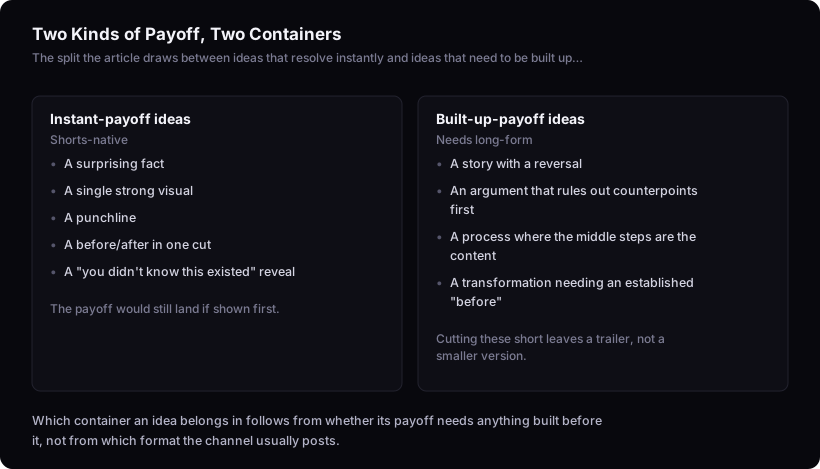
Instant-payoff ideas: a surprising fact, a single strong visual, a punchline, a before/after in one cut, a "this exists and you didn't know" reveal. None of these need the viewer to have sat through anything. You could start the video at the payoff and lose nothing.
Built-up-payoff ideas: a story with a reversal, an argument that has to rule out the obvious counterpoints first, a process where the middle steps are the actual content, a transformation where the "before" state has to be established and believed before the "after" means anything. Cut these to sixty seconds and you don't get a short version of the same idea — you get a trailer for an idea that never happens.
This is the same judgement that goes into finding an angle: the angle is the thing that makes an idea worth telling, and here it also tells you which container can hold it without breaking it.
What Shorts discovery rewards, and what it can't carry
Shorts discovery works through rapid, low-commitment feed serving — a viewer swipes past anything that doesn't resolve fast, so the format rewards ideas that resolve fast. There's no tab open, no click, no decision to watch this specific video over another one in a list. The viewer is already watching something and the next thing has to justify itself in the first second or two.
That mechanic is exactly why setup-dependent ideas die in this format. If the payoff is at second 40 of a 55-second video, most of the audience swiped away before they had any reason to trust that a payoff was coming. You can't front-load an argument's conclusion without also giving away why anyone should care about it, and a Short doesn't give you the room to build that care first.
If a Short isn't landing, the more common failure is a mismatch between idea and format rather than a fixable clip length — worth checking against why your youtube shorts aren't getting views before assuming the cut itself was wrong.
What long-form discovery and retention require that Shorts don't
Long-form discovery runs through search and suggested placements that weigh how well a video matches what a viewer typed or has been watching, and how long they stay once they click. That system is built around videos where a viewer has made an active choice to invest attention, which only makes sense for ideas that reward sustained attention.
A built-up idea has somewhere to put that attention: establishing stakes, ruling out the easy answer, tracking a change over time. An instant-payoff idea, stretched to meet a runtime, has nothing to put there — it pads, and padding is what a viewer notices right before they click away, which then tells the ranking system this video didn't hold anyone. The format and the idea either share a shape or the mismatch shows up in the graph.
If you're unsure what runtime a given idea can actually sustain, that's a separate question from the format choice — see how long should a youtube video be? for how to size a long video once you've decided it should be one.
When one idea legitimately becomes two videos
Some ideas genuinely support both a Short and a long video, but only if each version is restructured for its own container, not trimmed from the other. A Short built from a long video's best single moment is a repurposed clip. A Short built from scratch, as its own instant-payoff unit, is a second video.
The long cut earns its length by building the case — the failed attempts, the wrong turns, the reasoning that makes the ending land as earned rather than arbitrary. The short cut throws that reasoning away and keeps only the payoff, presented as a self-contained fact or moment. If someone watches both, the Short should feel like a different, smaller thing that happens to share a subject, not a preview or a summary.
Whichever version you publish first, it still needs a thumbnail and title that resolve fast — the clarity-plus-curiosity test we trust most applies to both formats: the premise obvious at a glance, the outcome withheld.
What no format choice can fix
Routing an idea to the right container doesn't guarantee it performs. Format match removes one specific kind of failure — a good idea dying because it was compressed or padded against its own shape — but it says nothing about whether the idea itself is strong, whether the title and thumbnail earn the click, or whether enough of the audience is even looking for it that week. A well-routed idea can still flop, and a badly-routed one can occasionally survive on the strength of everything else around it.
This test also can't see your specific audience's habits. YouTube's suggestions lean on watch history and channel-level patterns that this framework has no access to, so a format that's structurally correct for the idea can still underperform for reasons that have nothing to do with the setup test.
A quick per-idea decision checklist
Run each new idea through this before deciding its format:
| Question | Points to Short | Points to long |
|---|---|---|
| Does the payoff work if shown first? | Yes | No |
| Does it need a build, stakes, or ruled-out alternatives? | No | Yes |
| Is the "before" state something the viewer has to be convinced of? | No | Yes |
| Would trimming it to under a minute remove the reason it's interesting? | No | Yes |
| Is the whole idea one visual, one fact, or one line? | Yes | No |
If an idea splits evenly down the middle, it's usually a long-form idea with a strong instant-payoff moment buried in it — pull that moment out as its own Short rather than trying to force one video to do both jobs. And if you're short on ideas to run through this test at all, that's a separate problem worth solving first, covered in how to find youtube video ideas.