Your channel name is not just a label people remember. YouTube's public documentation discusses relevance signals like title, description and metadata for videos; whether a channel name specifically factors into discovery is not something YouTube documents in detail, so treat that as a reasonable inference rather than a settled fact. Most naming guides treat the whole exercise as brainstorming plus availability-checking. This one adds the discovery angle with that caveat kept in view: reasoning about an undocumented signal, which makes a fitting name cheap insurance rather than a growth lever. This article covers both: how to generate a shortlist of candidates, and how to pressure-test them, including those availability checks.
This article works through where to start when you have zero candidates, when a keyword in the name helps, how specific to go, what renaming actually costs, and how to pressure-test a shortlist — including the availability checks (handle, search collisions, other platforms) — before you commit.
What a channel name is actually asked to do
As far as the public documentation suggests, a channel name is one piece of metadata among several that YouTube's systems can read for discovery, alongside title, description and how well your content matches what someone searched or is already watching — how much weight it carries is not published. It is not the only signal, and it is rarely the strongest one, but it is not decorative either.
This matters because most naming advice frames the decision purely as branding: does it sound good, is it memorable, is it available across platforms. Those are real concerns, but they answer a different question than the one worth asking first, which is what job the name does inside YouTube's discovery systems before it does any job with a human audience.
If the name does carry weight, a name that sets an accurate expectation and is consistently matched by what's in the videos is the version most likely to help — and if it carries none, an accurate name costs nothing. That asymmetry, not a measured effect, is the argument for choosing accuracy over cleverness. A name that sets an accurate expectation and a channel that meets it repeatedly is doing more discovery work than a name chosen for wordplay.
Why keyword-stuffing a name is a smaller lever than people think
Putting a keyword in your channel name will not substitute for content that matches what people search, and it will not rescue a channel that doesn't earn engagement. YouTube's own guidance on tags says they mainly help with misspellings and close variants rather than acting as a way to rank for anything you want; a keyword in a channel name plausibly works on the same narrow logic, though YouTube doesn't document channel names the same way.
A keyword in the name can help when someone's search terms are slightly off from your exact title wording, or when they're trying to recall a channel by topic rather than by its actual name. That's a real but narrow job.
So: a keyword in the name is worth including if it fits naturally and doesn't force an awkward or overlong name — put it wherever it reads more naturally, and decide the display name and handle as a pair — the availability check below tests them together. It's a tiebreaker between otherwise-equal candidates, not a reason to prefer an awkward name over a clean one, and it won't substitute for content that matches what the keyword promises.
Narrow name vs. broad name: the tradeoff nobody states plainly
A narrow, niche-specific name buys immediate clarity: someone hits your channel page and knows in one glance what they're getting, and that clarity means a visitor already looking for that topic doesn't have to guess whether the channel is relevant. The cost shows up later, if your channel's focus shifts enough that the name actively misleads about what's on the page.
A broad name buys flexibility. It doesn't box you into one topic, so if your niche moves as your audience or your own interests change, the name still fits. The cost is upfront: a broad or abstract name explains nothing on the channel page, so a visitor deciding whether to look around gets no help from it — the explaining a narrow name does for free.
Neither option is correct by default. To estimate how likely your topic is to drift, look at what you've actually made so far and what you have planned: if every video idea you can list fits under one specific format or subject, narrow is low-risk. If your list already spans several adjacent topics, or you can't describe your channel in one sentence without an "and," that's a signal you're likely to drift, and a broader name costs you less later. "Brandable and vague" is not a safe middle ground — it's usually the option that does the least work in either direction.
If you haven't settled on a durable topic yet, that's worth resolving before the name, not after — see how to find your youtube niche without guessing.
The real cost of renaming later
Renaming an established channel gives up accumulated recognition and whatever search association has built up around the old name. Concretely: check how often people search or arrive using your current name, count the external links and mentions that point at it, and confirm whether your @handle would also need to change or can stay separate from the display name — YouTube lets you change the display name and handle on different schedules, so check your current settings before assuming both move together.
This doesn't mean never rename. It means weighing concrete signals before renaming: whether people already search your channel by its current name, how many mentions or links elsewhere point at the current name, and whether your current handle is what people actually type when they look for you. Weigh that against the cost of continuing to operate under a name that actively works against you — one that misleads about content, or that nobody can spell or recall. Living with an imperfect-but-workable name is often the cheaper option. A name that's actively wrong for what you make is the case where the renaming cost is worth paying.
What renaming does not do is give you a free creative do-over.
A method for testing name candidates before you commit
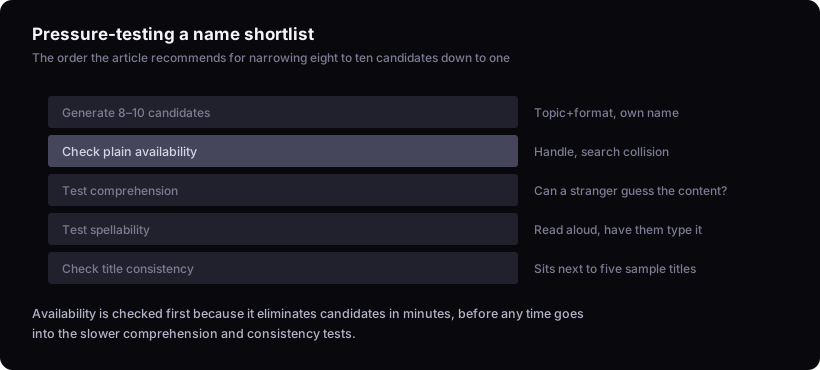
Before you have a shortlist, generate candidates with a few concrete approaches: pair a topic word with a format or persona word (what you cover plus how you cover it), consider your own name if you're the reason people would watch, or try an invented or compound word if you want maximum flexibility later. Write down eight to ten names this way, then narrow to three to five and pressure-test each one against four questions, not against how much you personally like the sound of it.
First: check plain availability — is the handle free, does the exact name already collide with an existing channel in YouTube search, and is it free on the other platforms you plan to use? These are checks you can run yourself in a few minutes and they eliminate candidates before you spend time on the rest.
Second: does someone unfamiliar with your channel understand, from the name alone, roughly what kind of videos they'll find? Ask two or three people outside your immediate circle to look at the name with no other context and tell you, in one sentence, what they'd expect the channel to be about. If they can't, or if they guess wrong, that's a mark against it, not a quirk to fix with a good banner.
Third: is it searchable and spellable the way people will actually type it? Read each candidate out loud to someone else and have them try to type it from memory. If they misspell it or guess a different word, that's a real cost.
Fourth: write out five plausible video titles for your channel and put each candidate name next to them, as they'd appear together on a channel page or in a subscription feed. Does the name read as consistent with those titles, or does it feel like it belongs to a different channel? Consistency between name and title style is part of what makes a channel page cohere, and it's one of the few tests you can run entirely on paper before you publish anything.
A failed title-consistency check is still information — it tells you which side to adjust. Usually that's the title style; occasionally it's the name, when every natural title fights it.
Where the name's job ends and the title/thumbnail's job begins
The channel name does its small piece of work every time it's read — in a search result, under a video, on the channel page — and that work repeats with every new viewer. Every individual video's click depends on its title and thumbnail, not on the channel name, and no channel name compensates for a weak title-thumbnail pair.
These are separate jobs and it's worth being exact about the boundary. A great channel name gets someone to check out the channel or recognize it in a search result. It does nothing for the video sitting in someone's suggested feed with a vague title and a cluttered thumbnail — that video lives or dies on its own packaging. If you want to fix underperforming videos, the name is very rarely where the fix lives; see how to write youtube titles that get clicks and how to make a youtube thumbnail that gets clicks for where that work actually happens.
Once a name passes the tests above, put the ongoing effort into the parts that get re-decided on every single upload — title and thumbnail — rather than continuing to second-guess the name itself.
What this can't tell you
This reasons from general naming logic and from the limited discovery-related guidance YouTube documents for titles, descriptions and tags, not from any test of specific channel names or measured before-and-after rename data. There's no public benchmark or dataset tying a particular name choice to measurable discovery outcomes, so nothing here can tell you whether one candidate name will outperform another for your specific channel. What it can do is give you a way to generate candidates, a way to filter them (including the availability checks above), and a framework for deciding whether a rename is worth its cost.