Copy this YouTube script template, fill it in, delete the parts that do not apply. The shape matters more than the wording, and the shape is the thing most scripts get wrong before the first sentence is written.
The arc it is built on
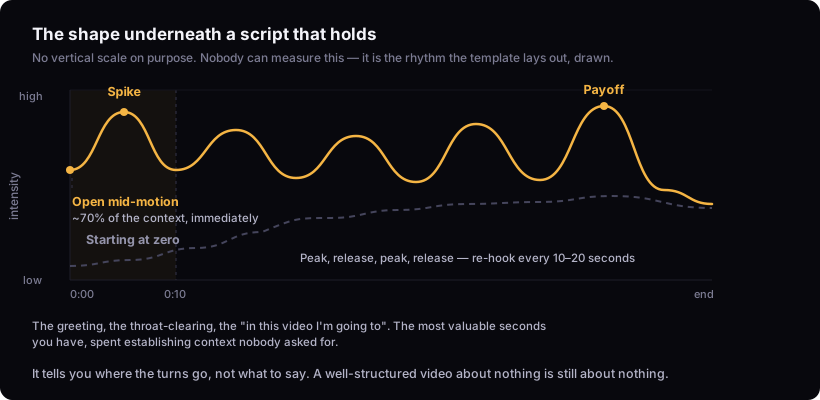
Most scripts that hold attention run the same rhythm underneath:
| When | The job | Intensity |
|---|---|---|
| First 5s | Drop the viewer into the middle of something already in motion. Give roughly 70% of the context immediately | High |
| 5–10s | Spike — a contrarian take, a stark number, a bold reveal. The first payoff | Peak |
| Body | Peak, release, peak, release. Re-hook every 10–20 seconds | Rolling |
| End | Close the loop you opened, deliver the payoff, then the CTA | Resolve |
The single most common failure is starting at zero: a slow wind-up, a greeting, some throat-clearing about what the video is going to be about. You are spending your most valuable seconds establishing context nobody asked for. Start at roughly 70% and let the remaining 30% arrive as you go.
The YouTube script template
HOOK (0:00–0:15)
 Open mid-motion. One sentence that confirms what the title
 and thumbnail promised — the viewer needs to feel they are
 in the right place before they will give you anything else.
 Then the spike: the contrarian line, the number, the reveal.

INTRO (0:15–0:45)
 Why this matters to them, in their terms, not yours.
 Establish why you are the one saying it — briefly.
 Preview the payoff without delivering it.
 Open the loop that has to stay open until the end.

BODY — SECTION 1
 One value beat. Deliver something usable.
 Close a small loop; open the next one.
 Re-hook: a question, a turn, a "but here is the part
 that surprised me".

BODY — SECTION 2
 Same shape. Vary the delivery — if section 1 was
 explanation, make this demonstration.

BODY — SECTION 3
 Same shape. This is usually where a video sags, so it
 is where the strongest single beat should sit.

PAYOFF
 Close the main loop. Deliver what the hook promised,
 fully, without hedging.

OUTRO
 One resonant forward-looking line. Not a summary —
 they just watched it.

CTA
 Woven into the content, not bolted on. The ask should
 follow naturally from what you just delivered.
Filling in each part
The hook has one job before it has any other: click confirmation. The first line must confirm the promise the packaging made. A viewer who clicked on a question and hears a different subject bounces within seconds, and no amount of quality later recovers them. Get that right and then be interesting.
The intro's credibility beat should be one sentence. Two is a CV. What earns attention is that the next thing you say is useful, not that you established you were allowed to say it.
Every body section must drive at the core promise. The test is blunt: cut the section and see whether the video still delivers what the title said. If it does, the section was filler and it was costing you the people who left during it.
Re-hook constantly. Every 10–20 seconds something should turn — a question raised, an expectation broken, a "but". Attention is not held by good content; it is held by the sense that something is about to happen.
The outro is not a recap. They just watched it. A recap says the video is over and there is nothing left, which is precisely when you want them to feel the opposite.
The section-length trap
Sections do not have to be equal, and making them equal is a tell. A five-minute explainer with three exactly-90-second parts reads as a structure someone imposed rather than a story someone told. Let the strongest beat run long and cut the weakest to a sentence.
Where this template stops working
It is a spine, not a script. It will not tell you what to say — only where the turns go. A well-structured video about nothing is still about nothing, and the structure will make that more obvious, not less.
It suits explanation, demonstration and argument. It does not suit everything. A vlog, a long-form interview, an ambient or ASMR piece — those run on different rhythms, and forcing this arc onto them produces something that feels engineered.
None of this is measured. These are craft frameworks, drawn from patterns creators teach publicly, and they are what our script writer applies. They are not a study and this article does not present them as one. Where PublishBench shows a measured figure it comes from the YouTube API and is labelled — how our data works.
Nobody can tell you a script's retention before you publish it. Structure improves your odds. It does not make them knowable.
Using it
Write the promise in one sentence first — what desire does this video satisfy, and for whom. Everything above only works if that sentence exists.
The script writer produces this shape as typed sections you can reorder, split and rewrite individually, at a target duration, following a brand voice built from your own writing. Scripts derived from an existing source carry an originality report showing the proportion of overlapping phrasing and the longest identical passage, as numbers rather than a pass or fail.
The full method is on structuring the script, and the opening on its own is covered in the hook formula.